 ES
ES  EN
EN  PT
PT  FR
FR 
Inside Voices
Change from the Heart of the Method
By Vijay Gupta
The girl was dying, and yet she sat bolt upright in her hospital bed, conducting us. My bow moved in sync with sixteen other children playing through Suzuki Book Five. As I played the Vivaldi Concerto in G minor, I stood facing Ms. Behrend and, for a split second, dared to take my eyes off my teacher, who conducted us with a hawkish glare and the whirling swish of her bow. The girl seemed older than me, ancient almost, though she couldn’t have been more than twelve. Her body was worn thin, her skin gray. And yet her eyes blazed. She was carried by the music, lit from within by something that did not belong to her body. I felt it move through her and back into us, the same current passing between us.
I had never seen someone so possessed, so alive, in music. It was as if she had become the very music I was playing.
A few weeks earlier, Ms. Behrend had taken our troop of Suzuki eight-year-olds to the stage of Carnegie Hall to celebrate the twenty-fifth anniversary of her academy, the School for Strings. We had prepared for months, playing our Suzuki tunes, and a composer named Bruce Adolphe had been hired to write a piece called Gut Feeling—the first time I played in mixed meter and stood with a living composer in the same room.
As we rehearsed, Ms. Behrend had to remind us how to perform, because the audience stretched out before us in rows of red velvet seats. “Remember, people listen with their eyes,” she said. When the spotlights came up, I couldn’t see a single one of them, and because I couldn’t see them, I had to perform at them. I didn’t know how I’d played until Dad took my brother and me to the Carnegie Deli and bought us pastrami sandwiches bigger than our heads.
After the Carnegie performance, Ms. Behrend took us to the Rusk Institute of Rehabilitative Medicine at NYU to perform for children with terminal cancers. In this room, I could see my audience. I could see them laughing and applauding, some with canes, some in wheelchairs. I could see that they were so much like us, and so different from us.
On the car ride home to the Mid-Hudson Valley, my brother asked Dad why some of the children were bald. Dad wasn’t his usual cheery, chattering self. He tapped the ash of his cigarette and said in our mother tongue, “Ekdin tora bujbi.”
One day you’ll understand.
My first practice room was Mom’s kitchen. I stood on a square of green construction paper and squeaked through “Mississippi Hot Dog” and “Run-Jimmy-Run-Jimmy” while she stirred fried onions in ghee and roasted cumin at the stove. She’d read Alimentados por el amor and taken Dr. Suzuki’s recommendation that parents practice with their children to mean supervising me with a turmeric-stained spatula.
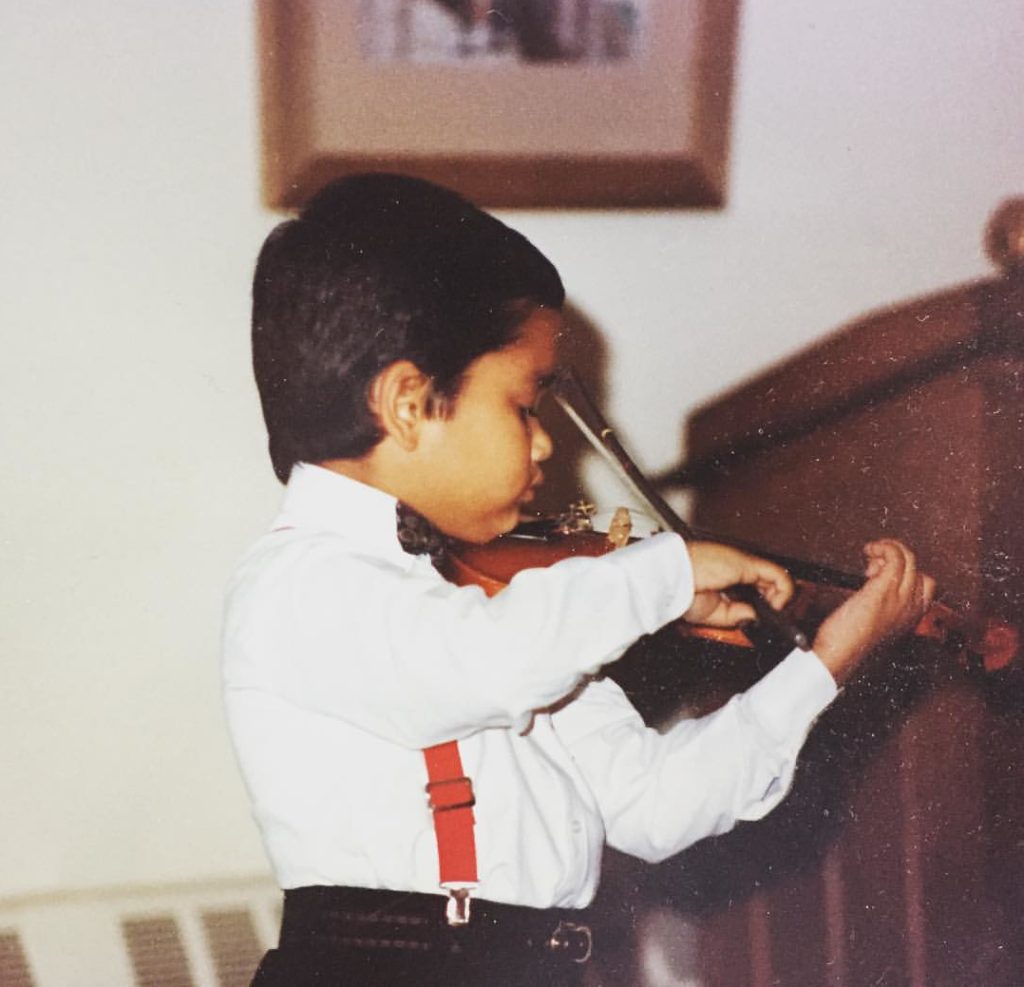
I had a Suzuki practice journal, wire-bound, with a cartoon duck that shouted the method’s aphorisms at me: beautiful tone, beautiful heart; listen, listen, listen; every child can learn. Only practice on the days you eat.
My kitchen sessions only ended when Mom placed a steaming plate of bhaath, daal, and thorkari in front of me and called me to the table in Bengali.
“Ai shona, kha.”
On the days I practiced extra, I made sure to eat extra too.
But the Mid-Hudson Valley was not a place for the round syllables of my mother tongue. When a teacher poked fun at my curled r’s and t’s, she threatened to hold me back a grade, to put me in ESL. After my brother and I got into Juilliard Pre-College, another elementary school teacher said we “might be good at music, but we would never be good at math.” So we stopped speaking Bengali at home, and Mom taught us algebra four years before we’d encounter it in school.
Home was not a safe place either. My brother and I, caught between our parents’ arguments, learned early that the air could change without warning. Once, in the middle of one of those moments, a hand snapped my bow, which burst into white horsehair. I understood, without being told, that if I kept playing, the world might hold together.
A year after I got into Juilliard, Dad pulled me from Ms. Behrend’s studio. He had seen how music had taken me to Carnegie Hall, and now, he had his eyes set on even bigger stages, which meant that my Suzuki days were over. I now had teachers who sneered at my bow grip from behind desks, or made me wait in a fifth-floor hallway for four hours, only to eat a fried chicken dinner during my lesson.
I still practiced the same way I had as a child in Mom’s kitchen—repetition—but without listening. I copied Itzhak Perlman’s fingering for the Mozart Sinfonia Concertante or played along with Isaac Stern’s Symphonie Espagnole, repeating each passage until it could be executed by rote. The music I once loved now hollowed into muscle memory.
There was still a love for music I could not reconcile with what was being asked of me. I was still chasing that current I’d felt at the Rusk Institute—in Brahms, Beethoven, Schubert—the moments where I felt most like myself, and also beyond myself. Where I could become music.
When the twin disasters of September 11 and Priceline.com caused Dad’s travel agency to fail, my parents pressed me toward medicine. After a few years of ruining Western blots and pretending to care about putative kinases, I returned to what had become the Gupta method: memorize and perform orchestral excerpts. A concertmaster told me I had to become “bulletproof.” I learned to play that way—armored, exact, nothing risked. I practiced until each piece became a series of athletic feats. Absolutely nothing could go wrong.
And nothing did, and then, everything did. I thought that winning my first orchestral audition at nineteen—becoming the youngest violinist to join a major American orchestra—would return me to that current. Instead I found myself a section violinist, playing full symphonic programs week after week, learning music just to survive. Within months, I felt a burning in my ribs that would become bursitis. Within a few years, I had become one of the orchestra’s professional drinkers.
I was numbing the pain of playing, yes—but also something I couldn’t yet name. Onstage, in the spotlight, on tour across the world—I drank to close the distance between what I was playing and what I felt. The beautiful tone. The beautiful heart. I had stopped believing they had anything to do with each other.
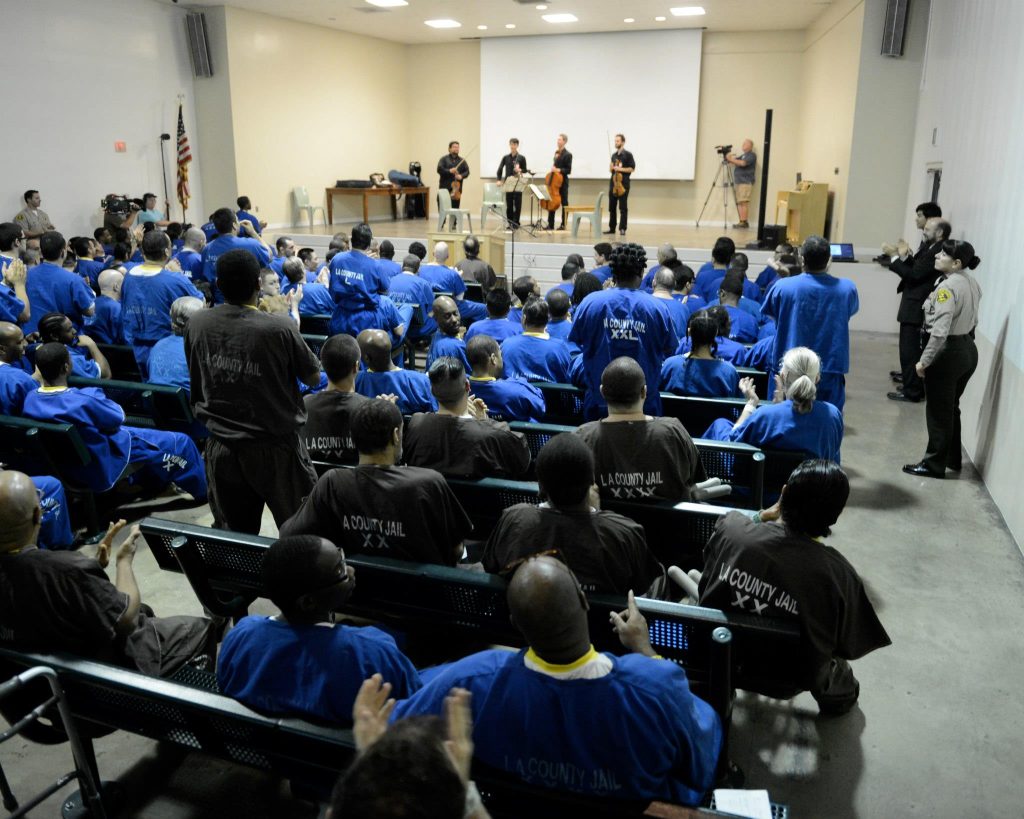
When I first started cold-calling clinics and shelters, I didn’t quite know why I was doing it. I had been playing for audiences in VA hospitals and chemotherapy wards across LA County, trying to move beyond the Philharmonic’s outreach concerts, which too often felt like photo ops—safe enough for a few movements of a Beethoven quartet, one donor, and a group of executives scrolling through emails.
My first attempts were no better. People fell asleep in shelters. I bombed in a state hospital. I got heckled in a county jail. I had come in assuming that training, pedigree, and profession made me the only consequential musician in the room, only to find that the room was already full of people who had made music their entire lives—not as a form of entertainment, or prestige—but as a lifeline.
The other thing that mattered in Skid Row was that I could see my audiences again, the way I’d been able to see them at the Rusk Institute. I could see what they carried, how they bore the burdens of their lives. And they could see me—more honestly than I could see myself.
“What’s eating at you, baby?”
A woman asked me this after a performance of Brahms’s Clarinet Quintet. I had no idea what she meant. Another man told me to keep walking my steps.
I wasn’t aware yet that I was becoming addicted to alcohol, or that I was using food to disappear into myself. I was using the spotlight of Disney Hall to hide my shadow. But under the fluorescent lights of clinics, and shelters, and county jails, I couldn’t hide my shadow from people who had walked through their own darknesses—who had survived the shadows of addiction, poverty, and homelessness. I had thought I was bringing the joy of great music to people surviving their darkest moments.
But after some time, the slogans of recovery—keep coming back, one day at a time, keep walking your steps—started to sound like the cartoon duck in my childhood Suzuki journal, asking for repetition and return, asking to be nurtured with love—asking me to do the unthinkable work of healing myself in order to truly heal the world.
In Skid Row, I understood something I had first felt at the Rusk Institute and then spent twenty years trying to find again: that music cannot hold the world together because of the domination of talent, imposed upon by an infallible expert—but rather, in precious, utterly fleeting moments of transcendence, shared reciprocally between musicians and their audiences.
In Skid Row clinics, shelters, and county jails, I began to learn, again, how to begin.
What was Dr. Suzuki’s hope, working with children one generation after two bombs, and still insisting on the audacity of simple, beautiful music, a soul-shaking sweetness? The more time I spent in shelters, clinics, and jails, the more I began to think that this, too, had always been part of the method, though no one had explained it to us as children.
Suzuki’s method was never only a system for producing good little violinists with high fingers and a perfect V-foot stance. It was a wager on the human being—on the possibility that attention, repetition, and nurturing love might restore dignity where the world had shattered it. The destination was never Carnegie Hall. The destination was within: in the restored relationship between a child and her own capacity, between a sound and the person it reaches, between the musician and the room. What my parents misunderstood—what I misunderstood—was that the method was already complete the moment the music passed between us and the girl in the hospital bed, her eyes blazing, conducting us home.
Perhaps our work now is to restring ourselves between these poles: from the Carnegie Halls to the Rusk Institutes, from the Skid Rows to the Disney Halls, and to find the song that happens in the tension of those broken places between us, and within us.
Beautiful tone, beautiful heart.
Author’s note: I would like to thank my Suzuki teachers Karin Warner, Donna Kushner, and Louise Behrend. I’d also like to thank my friend, Dr. Erik Elmgren, and ASJ Editor Andrew Braddock.
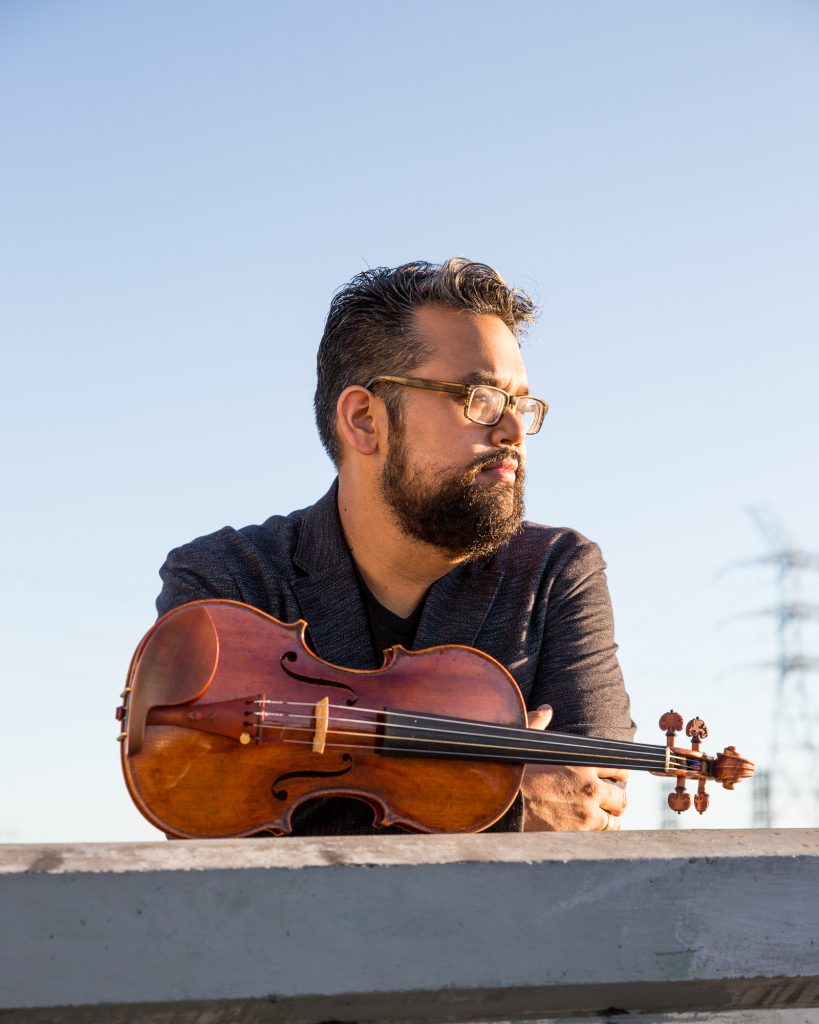
Vijay Gupta is a violinist, speaker, and writer whose work weaves together music, neuroscience, and lived experience to explore how people learn, adapt, and find meaning under pressure. His work speaks to students, entrepreneurs, artists, and communities seeking resilience, belonging, and purpose. A recipient of the MacArthur Fellowship, he is the founder and Artistic Director of Street Symphony, a nonprofit bringing music into shelters, clinics, jails, and reentry spaces across Los Angeles. A former youngest-ever member of the Los Angeles Philharmonic, Gupta speaks widely to universities, healthcare systems, companies, and public audiences. His memoir Restrung will be published in 2026. Photo by Kat Bawden.