 PT
PT  EN
EN  ES
ES  FR
FR 
Kanban for Musicians
A Workflow System for the Suzuki Triangle
By Linda Piatt and Julia Pautz
The Kanban Innovation
In June 2025, San Diego Symphony violinist Julia Pautz and her ten-year-old son Jackson returned from an extended family vacation, suddenly faced with a compressed timeline: just twenty-one days to prepare Boccherini’s Minuet, his “half-a-book back” piece, for a Suzuki Institute recital. In his first lesson after vacation, Jackson’s Suzuki teacher, Linda Piatt, provided clear goals for a polished performance, delivered in tiny nuggets so that he could perform the material successfully within a few tries. What might have been a moment of stress became an opportunity for strategic focus and creativity. Collaboration among the Suzuki Triangle led to the application of the Kanban Method in Jackson’s practice. This powerful system transformed his practice process into a structured, transparent, and highly effective endeavor.
Inspired by an episode of the HBO series Silicon Valley, Julia had already introduced the Kanban Method to one of her own students. Recognizing its potential, she adapted Kanban for use with Jackson, applying it to organize his assigned practice nuggets, with remarkable results. This effective solution to Jackson’s short-term challenge inspired Linda to implement Kanban broadly in her studio. She has since developed musical applications of the Kanban Method into a formal presentation for the 2026 Biennial SAA Conference, and created a resource portal on her website.1
What is the Kanban Method?
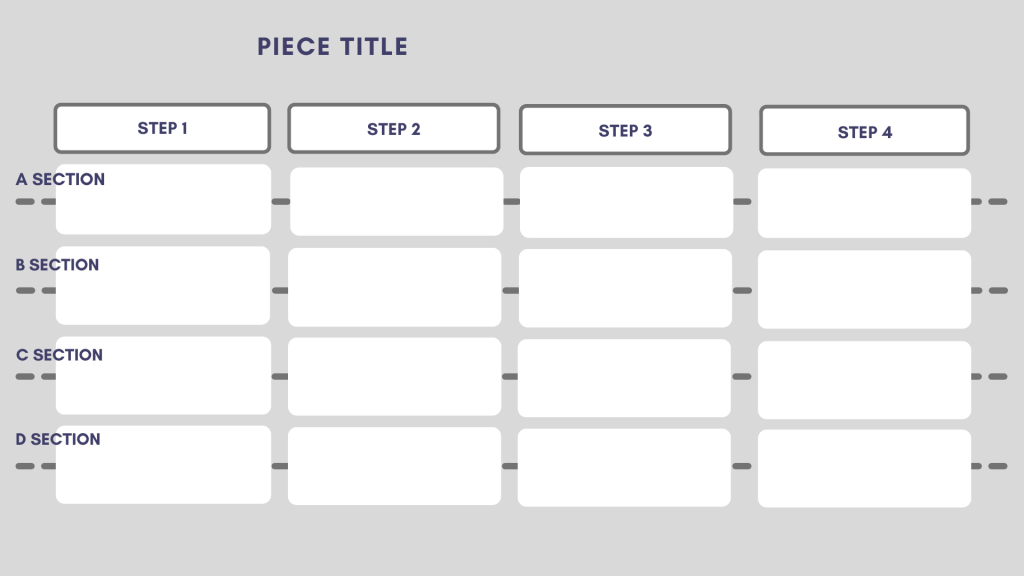
The Kanban Method debuted over seventy years ago as a workflow management system to streamline and visualize progress of complex projects. A Kanban board contains fixed columns and moveable Kanban cards. Figure 1 shows a typical Kanban board, containing three columns representing stages of progress. Kanban cards, (often made from sticky notes) each representing individual tasks, migrate across columns from left to right across the board when the defined criteria and goals are met, merging at the end to become a completed, polished project.
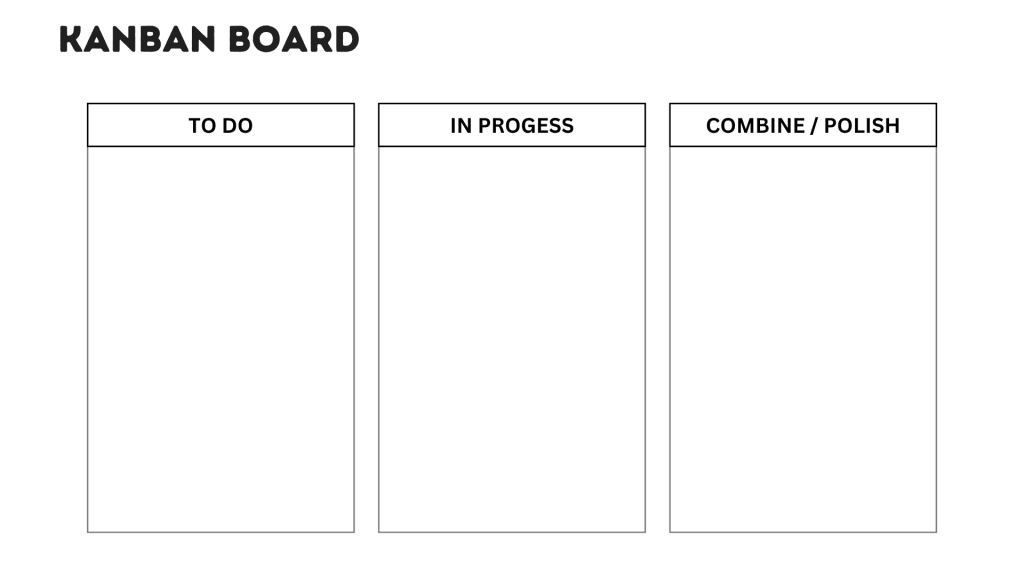
Practice nuggets are first placed in the “to do” column. Once there is room for new material, a nugget moves to the right “in progress” column. The teacher introduces the nugget and criteria for this Kanban card. Also, as Ronda Cole reminds us: “It is important that nugget practice be done in the lesson so that the family knows what to expect and what the standard is. . . . The assignment given at the lesson is the prescription for advancement.”2 When defined criteria and goals are met, the nuggets merge into the “polishing” column where sections come together, technical achievements intact. This aligns with the step-by-step skill-building approach of the Suzuki Method.
Cornerstones of the Kanban Method
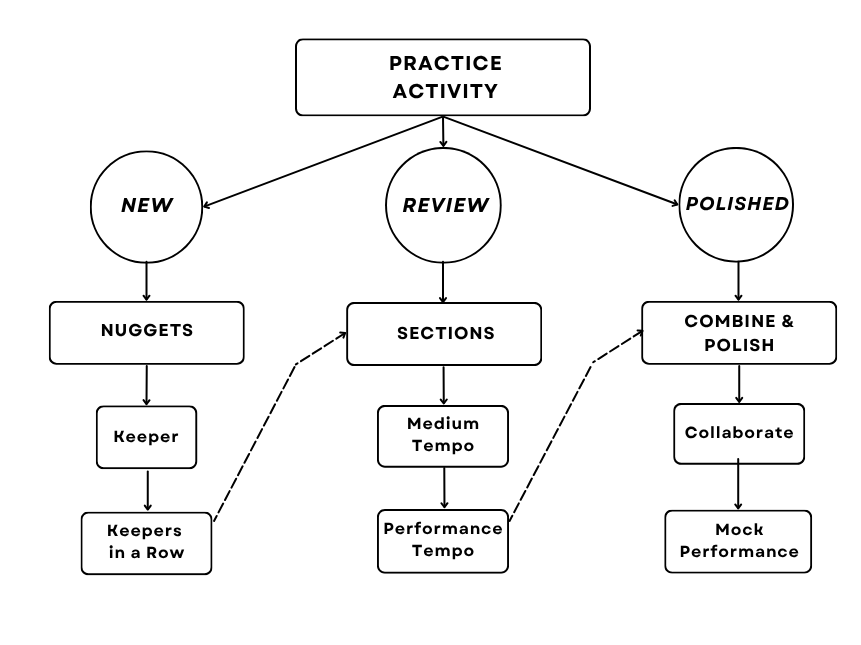
1. Visualize Workflow: When teachers reveal the workflow, students see where they are, what they are working on, and what comes next. This is the first cornerstone of the Kanban Method. Foundational music pedagogy is based on a “parts to whole approach.” As progress is made, activities become bigger, tempos increase, and the stakes rise. Kanban boards provide a visual, tangible, and interactive representation of this progression. With a clearly defined path, music practice transforms into a concrete and motivating experience. Figure 2 shows a sample visualization of workflow in music practice.
For Jackson, the Kanban Method demystified the whole process of adding details and polishing a piece. Referencing Linda’s assignment sheet with the corresponding tab in the music and the Kanban cards, Jackson and Julia witnessed measurable progress with every single practice session. Instead of applying time uniformly across every nugget as assigned, Jackson could decide which cards to focus on and push forward. According to Jackson, “Kanban made me want to push, because I could see I was being successful.” For kids who need visual evidence of their progression, this method has enormous potential.
For Julia, having Jackson spot the nuggets that needed attention alleviated the pressure on her to provide perfect feedback and enabled Jackson to take appropriate ownership of his own efforts. Instead of needing to convince Jackson that certain assignments needed special attention, she relied on Jackson to spot the bottleneck. Julie was able to make the shift from gatekeeper to facilitator. As his teacher, Linda was able to enjoy a celebration with Jackson when he returned for his subsequent lessons, consistently delivering successful repetitions of his assignments and advancing in the repertoire.
2. Work In Progress (WIP) Limits: Limiting the cards to a manageable number kept Jackson in the zone and insulated him from feeling overwhelmed, a common problem from his past. The second cornerstone of the Kanban Method is WIP Limits, a truly distinguishing feature of Kanban. The WIP is the number of tasks a musician is working on; WIP Limits are the number of active tasks allowed in each column. New work can only be “pulled” onto the board if space is available. This strategy allows tasks to flow steadily across the board and keeps the focus on finishing what was started. Rather than getting overwhelmed, students see a solvable puzzle. They learn to strategize, prioritize, and see their commitments through to the end.
For the home-practice unit, Kanban makes visible the progress that was previously granted only by the teacher. Progress is now actively visible and tangible to students in real time. The shared goal of moving the cards to the end feels like a game, complete with the positive reinforcement of dopamine hits, highlighting a key principle of Amabile and Kramer’s notion of achievement: “Of all the things that can boost emotions, motivation, and perceptions during a workday, the single most important is making progress in meaningful work.”3
WIP limits parallel game mechanics which also require clear and explicit rules of play. Games impose constraints to create challenge and excitement. Similarly, Kanban transforms practice into a structured, “winnable” system where progress is visible, goals are clear, and effort is rewarded through movement across the board.
3. Managing Flow: Another key feature of the Kanban Method is managing flow. Tasks ideally flow as evenly as possible across the board, without long wait times or blockages. If the flow is disrupted, this can springboard productive team discussion to look for a mutually agreeable solution. The Suzuki Triangle can collaboratively adjust WIP Limits, redefine criteria for advancement, or redistribute effort in service of flow.
Establishing criteria clarifies how Kanban cards move across the board and maintains quality control.
- Who pulls a task onto the board, and when?
- Who moves a task to the next column, and when?
- When do we decide to remove a task from the board?
Although your criteria will vary depending on the student and assignment, whatever you establish will be the key to creating a layered practice assignment that allows students to take charge of their progress and helps them decide when an activity can flow to the right on their Kanban board in between lessons.
As a child still developing impulse control, Jackson really wanted to get to move cards. To maintain his ownership of the process, Julia would ask him to consult Linda’s notes for “keeper” criteria. Sometimes, Julia allowed Jackson to move a card prematurely to the next column, creating a learning opportunity with Linda at the next lesson.
Both Kanban and games challenge players to strategize and flow toward a conclusion. A player may decide to prioritize a pawn that is close to home, make an investment, or to employ a superpower. In much the same way, a musician can strategically design their practice activities to advance through the repertoire.
Types of Kanban Boards
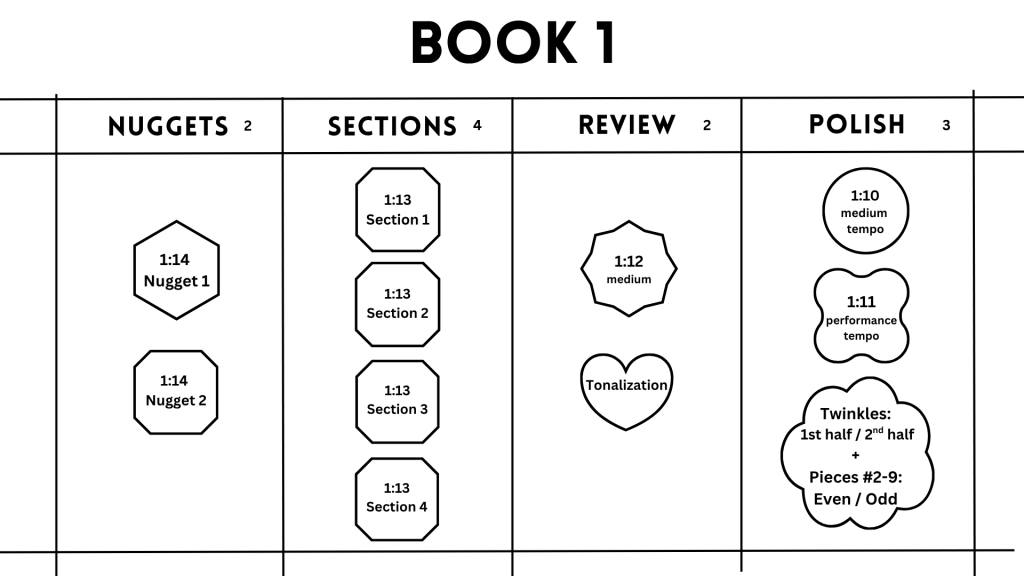
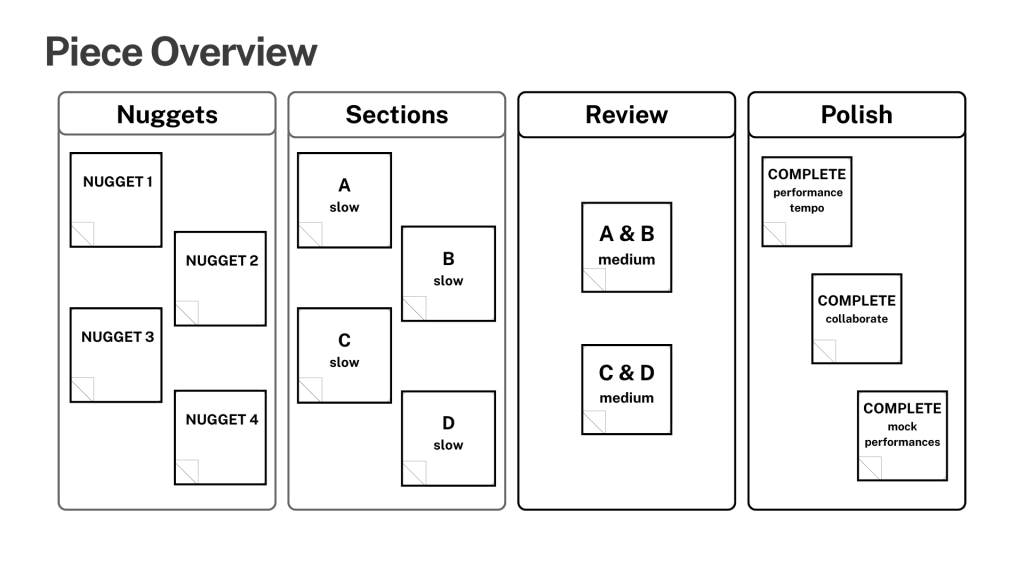
Flexibility and customization are hallmarks of the Kanban Method and provide the opportunity for much creativity. Boards may represent an entire practice workload or focus on a single piece. Tasks can be differentiated by color, shape, or tactile elements to accommodate diverse learning needs and provide opportunity for choice and novelty. Physical boards may be constructed from simple materials such as paper, poster boards, walls, or cabinets, or adapted into digital formats. In some cases, students may develop a Kanban board inside their mind. Photos of Kanban boards in action and downloadable templates are available in the Kanban Portal (see note 1). Figures 3, 4, and 5 provide examples of Kanban boards. Using a highlighter tape and notebook can also be a powerful tool for pinpointing nuggets and capturing the criteria that needs to be met. A highlighted spot in your music, corresponds to a color-coordinated kanban card, and a spot in their lesson notes that expands on the goals.
Comunicação
Communication plays a central role in sustaining the effectiveness of the Kanban Method. In Suzuki music practice, similar to games and team sports, the Suzuki Triangle and community are a team. In the interest of succeeding as early in the process as possible, early feedback is essential to ensure the musician is on the right track and everyone is aligned with the goals.
Digital tools such as shared notes or docs, video messaging platforms, and gamified practice apps can enhance this communication and provide layers of accountability and engagement. Recommendations are available in the Kanban Portal.
For this home-practice unit, referencing the teaching point videos at home, and sending a “keeper” video to Linda for confirmation that a card was eligible to progress proved an important part of the workflow. Simply recording the practice nugget often led to increased focus by Jackson, and an improvement in reliable results. This objective approach also improves parent/child communication since the parent is not held responsible for providing corrective feedback.
Suzuki Core Tenets
The Kanban Method aligns with Suzuki ideals by providing a purposeful system to build processes that support musical and personal growth.
- The Suzuki Triangle: Everyone is successfully and equally engaged using the Kanban Method. A well-balanced Suzuki Triangle is Suzuki education at its best.
- Step-by-Step: Cumulative skill development and sequential learning are at the heart of Talent Education and provide repeated opportunities for students to be successful.
- Belief in the Child: Kanban boards reinforce the teacher and parent’s belief in the child. The board is a visual representation of the teacher’s vision for a student, and helps them see that they can achieve more than they thought was possible. The Pygmalion Effect contends that this higher vision leads to improved performance by the student, like a self-fulfilling prophecy.
- Character Development: The Kanban Method cultivates habits of discipline, persistence, self-regulation, and reflective practice, all of which contribute to the development of the finest character.
- Positive Environment: When students are empowered with knowledge, equipped with practice tools, and engaged in their learning, their results are predictable and desirable, fueling joy and motivation.
Conclusão
With the help of the Kanban board, Jackson presented a beautifully polished version of Boccherini Minuet at the San Diego Suzuki Institute student recital in July 2025. He internalized the hallmark Boccherini bow division, left-hand organization, and phrasing, and performed with great ease and finesse which was deeply rewarding to all the sides of the Suzuki Triangle.
We truly hope this article has sparked some engaging practice ideas for you. We also welcome questions or suggestions, and would love to see photos and videos on Kanban in action in your studio! This technique can benefit all learners, regardless of age and playing level. Please feel free to connect with Julia and Linda at lindapiatt.com/kanban.
Notas
1. “Kanban for Musicians,” Linda Piatt, https://www.lindapiatt.com/kanban.
2. Ronda Cole, “Assignments” American Suzuki Journal 31(3), Spring 2003: 23.
3. Teresa Amabile and Steve Kramer, “The Power of Small Wins,” Harvard Business Review, May 2011: 4.
Linda Piatt is a private violin and viola instructor, and performs professionally with the Hutchins Consort, and the California Chamber Orchestra among many other ensembles throughout Southern California. She is founder and director of the nonprofit organization, Mosaic Chamber Music, and a popular session presenter at conferences such as SAA/ASTA and American Viola Society. Linda is the current President of the Suzuki Music Association of California, and also serves on the Board of Directors for the Southern California Viola Society and American Federation of Musicians, Local 325. She is the proud recipient of the SAA Distinguished Young Teachers Award and the SAA Certificate of Achievement and has registered all violin and viola SAA Unit courses. Linda holds a Bachelor of Music from University of Texas at Austin, and a Master of Music from University of Minnesota where her primary mentors were Sally O’Reilly and Korey Konkol.
Hailed as a “genuine virtuoso” by the Dallas Morning News, Julia Pautz joined the violin section of the San Diego Symphony in 2010. A passionate chamber musician, she also performs as a founding member of the Artonic String Quartet, and is the co-founding executive director of the non-profit chamber series Blanco Performing Arts, based in her hometown outside Austin, an organization she runs with her mother Vickie Pautz, a registered Suzuki Piano Teacher Trainer. Julia teaches a cohort of high school violinists in La Jolla, focused on college prep for music and non-music majors, and has been a Linda Piatt studio parent for seven years. A student of Linda Cerone and Robert Lipsett, Julia holds degrees from the Cleveland Institute of Music, the University of Southern California, and the Colburn School.