 EN
EN  ES
ES  PT
PT  FR
FR 
Turning Students Into Teachers
The Role of Group Lessons in Creating a Suzuki Community
By Clarke Bonten
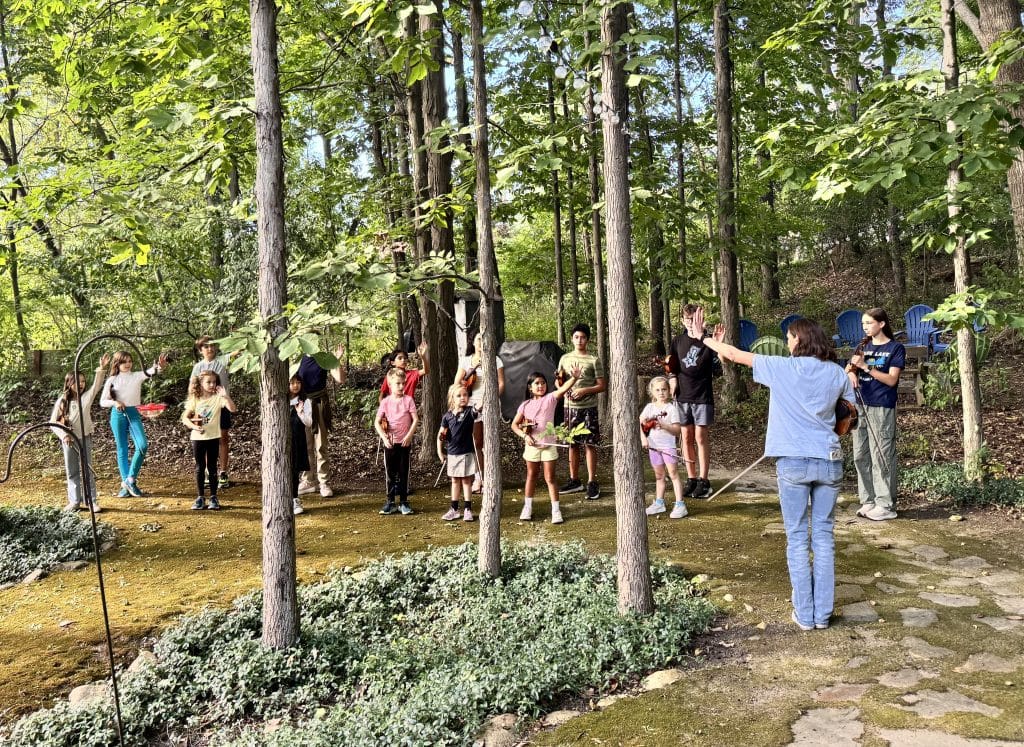
It’s 4:58 on a typical Wednesday afternoon at my wooded house on the top of the hill. I am just finishing up Luke’s lesson, and the house is already ablaze with the sounds of tiny violins mixed with cheerful greetings. Parents are mingling, teens are sharing stories about what their conductor said at orchestra this week, and a lone Pre-Twinkler is excitedly playing through his newly learned “Bread of Twinkle,” in hopes that he can play it with the group this week. As Henry and I transition from a private lesson to group, Bella and Alice have already begun to tune tiny violins and direct students to their group lesson sites. Today, on a beautiful autumn afternoon, the Book One and Two students will be outside on the back deck, the Pre-Twinkle class will be in the atrium, and the advanced class will be in the basement. I follow my group to the basement, excited to be able to hone in on shifting this week, and gratefully confident that the rest of my students are in good hands.
My relationship with group lessons has taken many forms. I’m sorry to say that I wasn’t always committed to the Suzuki group lesson. But I have since grown to understand its essential importance in building a community, shaping engaged students, and even in developing future teachers.
Prioritizing the Weekly Group Lesson
In my early days of teaching, I taught in a large program at a community music school, and every student had weekly group lessons. But when I moved away and began teaching privately, group lessons did not seem practical. Many of my students drove from great distances for lessons, my student age range and levels were spread out, and it was difficult to fit groups into my schedule. Over the years, I experimented with different ways to implement groups, ranging from rotating groups from week to week, having Play-Ins once a month, and teaching a single, large mixed age/level group. But each of these situations came with its own set of problems, and without the regularity of group each week, I found there was a lack of cohesion and structure.
As my daughters and their friends entered their teenage years, I came to believe that a strong Suzuki community is the most important thing I can offer my students. The best way for me to achieve that is through the weekly group lesson. So, the scene from the beginning of this article is what every Wednesday looks like in my studio. Every student in my studio attends group class each week, and the groups are divided by level. I currently have two assistants, my sixteen-year-old daughter Alice, and a graduate of my studio, Bella, who both lesson plan with me each week and lead their own group classes. To help enrich this growth, I record teaching videos for them to watch, co-teach with them on occasion, and set aside time after group each week to discuss the lessons and answer any teaching questions they have.
Students Into Teachers
Many years ago, I taught a student named Hannah. She was a lovely girl, quite passionate about her violin playing, but she had a dreamy air to her, and had a terrible time remembering what to focus on. Hannah was part of a homeschool community, and around the time she was twelve years old, a mother in the community asked Hannah if she would teach her five-year-old daughter to play the violin. It was quite common in their homeschool group for older students to help teach younger students, and Hannah was quite excited to have her first violin student. We spent some time at her lesson talking about how to make a box violin, and I shared with her some of my early lesson plans.
As Hannah started teaching her young student how to hold the bow, something remarkable happened. Hannah, who had been struggling for years to improve her bow hand, suddenly became engaged. It started with her bow hand but quickly seeped into all aspects of her playing. She was more aware of tone and attentive to details such as bow placement and the angle of the stick. Not only did her technique improve, but her memory of pieces became easier. She was able to learn pieces with correct bowings, rather than having to go back and correct multitudes of mistakes. Her practice became more structured, and she seemed to suddenly become aware of the process behind the learning. This experience taught me a lot, and I now fully believe that teaching is one of the greatest pathways to learning.
Mentoring at Its Best
Many years after witnessing the profound effect of teaching on Hannah’s development, I found myself in a position to provide this opportunity to my own teenage daughter. When my good friend and Suzuki colleague asked me if I had room in my studio to teach her grandson, Luke, I was conflicted. He had been taking lessons for a couple of years and was in the middle of Book Two, but with three children at home and a full studio, I had no room in my schedule. My daughter Isabelle was fourteen and a freshman in high school, and her interest in teaching was blossoming. This spurred an idea that was a win for everyone. We found a weekly lesson time for Luke and set it up so I would teach him the first week while Isabelle observed. After the first lesson, Isabelle and I talked through the progression of the next three lessons. Initially, I observed her teaching each week, giving feedback and offering guidance. After the four-week cycle, I would teach another lesson, repeating this sequence. Initially, Isabelle followed the lesson plans down to every detail. But as her confidence grew, I started to notice her diverging. She became more spontaneous, reacting to what was actually happening in the lesson as opposed to what we predicted would happen.
Isabelle continued to teach Luke until she left for college this past September, taking him from a Book Two student to a confident, capable Book Four student. He is now my student, and is as well prepared for the rigors of Vivaldi as if I had taught him myself.
Turning the “Terrible Teens” Into “Terrific Teens”
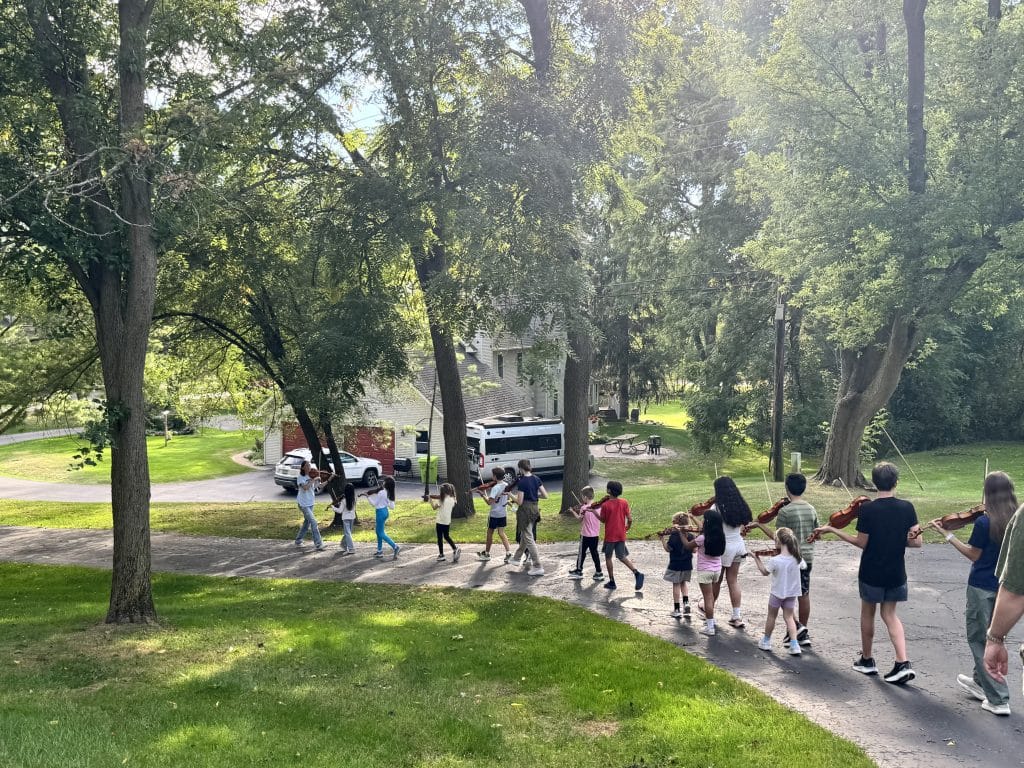
Even in small doses, welcoming students into teaching roles can create significant changes. The scene may look chaotic: around twenty kids with instruments, some playing, some talking, some noodling, and yes, one may be about to walk through the waterfall with a violin dangling from his hand. It is twelve-year-old Brett, one of my most advanced students. But rather than call him out for his foolishness, I quickly call him over to help tune. He transforms from troublemaker to teacher so quickly he doesn’t even know it is happening.
A similar scene occurred a week later in group class. We are sightreading a new piece for our holiday concert, and thirteen-year-old Sarah thinks it is too easy. She is bored, and her gut reaction is to play with an abrasive sound and terrible posture. I quickly swoop in, asking her if she can help teach it to Katie, who is struggling to read the notes. Sarah lights up, her sense of purpose quickly transforming her attitude from defiant to cooperative. These two students may not know it now, but over the next few years, they will have more opportunities to teach. Each time they lead a piece in group class, beginning with a breath or an introduction, or make a decision about a fingering or phrasing choice, we are paving their path to first independence, and then leadership.
Community and Motivation
As I reflect on the winding road music has played in the lives of my children, I recall a scene from many years ago. As I sat in my studio teaching Vivaldi’s A Minor violin concerto, I felt a little tug on my arm. There was no need to look down. I laid my violin on my desk, pulled two-year-old Isabelle into my lap, and continued to listen as Amelia counted out ten repetitions of the shift to third position. This was a typical scene when my children were young. They knew they were always welcome to come get a “snuggle” as I was teaching, as long as they were quiet and I could stay focused.
As they grew, the parents and students in our studio became their extended family, and their best friends were their violin friends. It was not until they were in school years later that they realized not everyone plays the violin! When Isabelle entered middle school in sixth grade, her friends at school got to choose band, orchestra, or choir. Having heard Isabelle play violin through elementary school, her closest friends chose a string instrument, and her school orchestra community was created. While I know she played a role in the creation of this environment, a bit of it was luck as well. Her best friend since first grade started lessons with me, progressed quickly, and, through both middle and high school, Isabelle was surrounded by peers who were musicians. They attended All-State Orchestra together, traveled to Spain and Portugal with their High School Orchestra, and played together in youth orchestra, as well as local symphony orchestras. I have no doubt that this “social immersion” of like-minded young musicians helped motivate Isabelle through her teen years. She is now in college studying violin performance and music education.
New Parents, Old Parents, and Everything in Between
It starts with a performance, the culmination of our six-week chamber music unit. The first group is made up of three seven-year-olds playing “Chorus from Judas Maccabeus” with harmony. It is their first time playing in a chamber group, but they have worked hard to learn about cueing, breathing together, and eye contact. The final group is a trio playing Mozart. They were able to recruit a cellist from the youth orchestra, and the three friends learned quite a bit about rehearsal techniques and time management in addition to the music. The performance is short, but the evening is packed. A pot luck dinner follows, and thankfully the weather is still nice as kids race through the woods and dance around a bonfire. As dinner winds down, I pull together a circle of chairs on the back deck for parents to gather. Alice and Bella, my group leaders, gather the students for a game of Music Jeopardy that they created.
The parent talk tonight is centered on the book Beyond the Music Lesson by Christine Goodner. Even though we read this book for our studio book club several years ago, I wanted the newer parents to get to read and discuss it, and for my older parents to revisit it from a new perspective. It did not take long for the conversations to get going. Everyone had “practice struggles” to share, and it was empowering for the veteran parents to laugh and share their experiences of what those early days were like. While I was there to guide the discussion, I found that I did not have to do much.
After an hour or so had passed in what seemed like a flash, I quietly snuck off to check on the Jeopardy game. When I entered the house, I was shocked to see Alice and Bella had the rapt attention of every eye. Twenty children, ages four through fourteen, were thoroughly engaged. I watched, mesmerized as team one selected “Ling Ling Challenge for $200,” then proceeded to “play twinkle while playing the violin like a cello.” When 7:30 rolled around and parents shuffled inside to collect their children, they were met with protests of “Just one more category! We are almost done!” I smiled as I realized that this is what every Suzuki parent wants to see: children begging to make music with friends.
What once felt like an insurmountable problem now feels like a gift. Triangulating group learning with community building and teacher development has led to my deeper engagement with teaching and the Suzuki philosophy. It brings me so much joy to see the love of teaching blossom in my students, and I am grateful to be able to play a role in their growth. Bella has now taken Suzuki Teacher Training through Book Two, and my daughter Isabelle is planning to take ECC in the upcoming year. It is my aspiration to become a Suzuki Teacher Trainer, and to someday be able to train my daughters and students as part of their Suzuki journey.
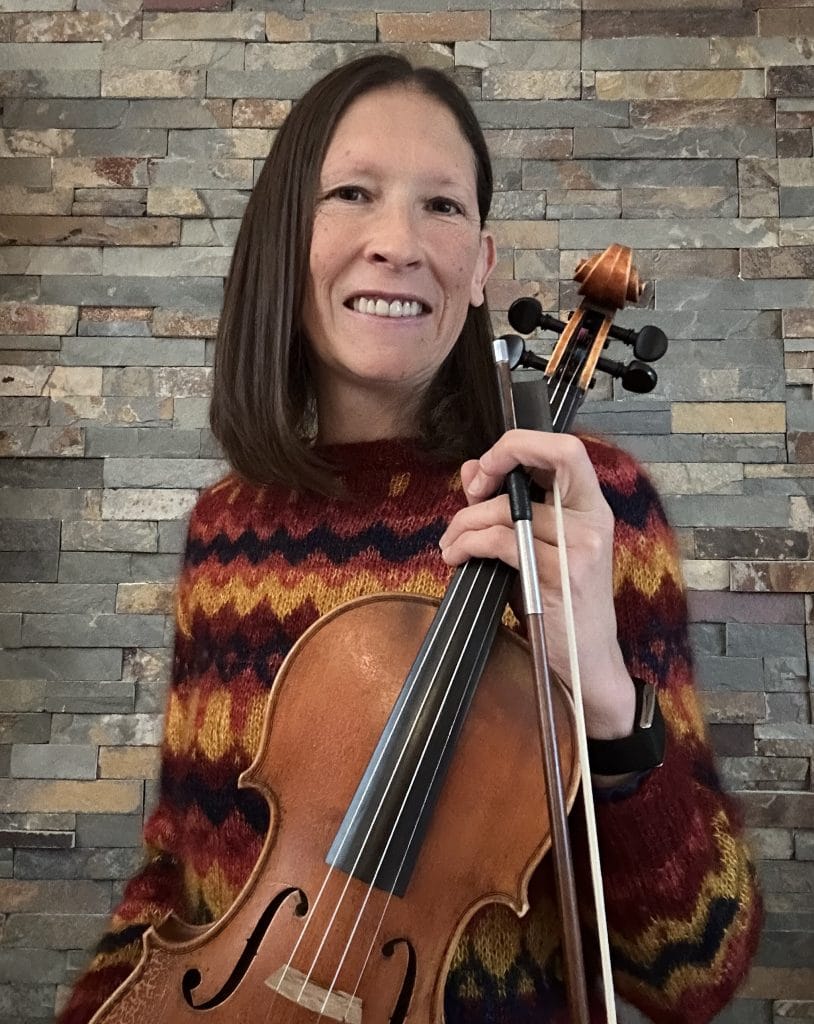
Clarke Bonten is a Suzuki Violin Teacher in Rochester, MI., where she runs a studio out of her home. Clarke began playing violin at the age of two, as a Suzuki student of Craig Timmerman. Clarke then studied music education at Michigan State University and went on to pursue Suzuki Teacher Training. After several years of teaching orchestra in the Walled Lake Public Schools, Clarke eventually shifted her focus towards her Suzuki Studio, where she now teaches students from Pre-Twinkle through post Book Ten. As an active member of her local music community, Clarke is a long-time member of the Rochester Symphony, worked with the local school board to institute an orchestra program in the Rochester Public Schools, and volunteers as Board President of the Oakland Youth Orchestras. Clarke is currently working towards her Certificate of Achievement and hopes to become a Suzuki Teacher Trainer.