 EN
EN  ES
ES  PT
PT  FR
FR 
Meet Me in NYC: Reflections from a Collaborative Suzuki Tour
By Carlough Faulkner-Carroll, Betsy Deming Kobayashi, Aimee Morrill Briant, Lori Scheck
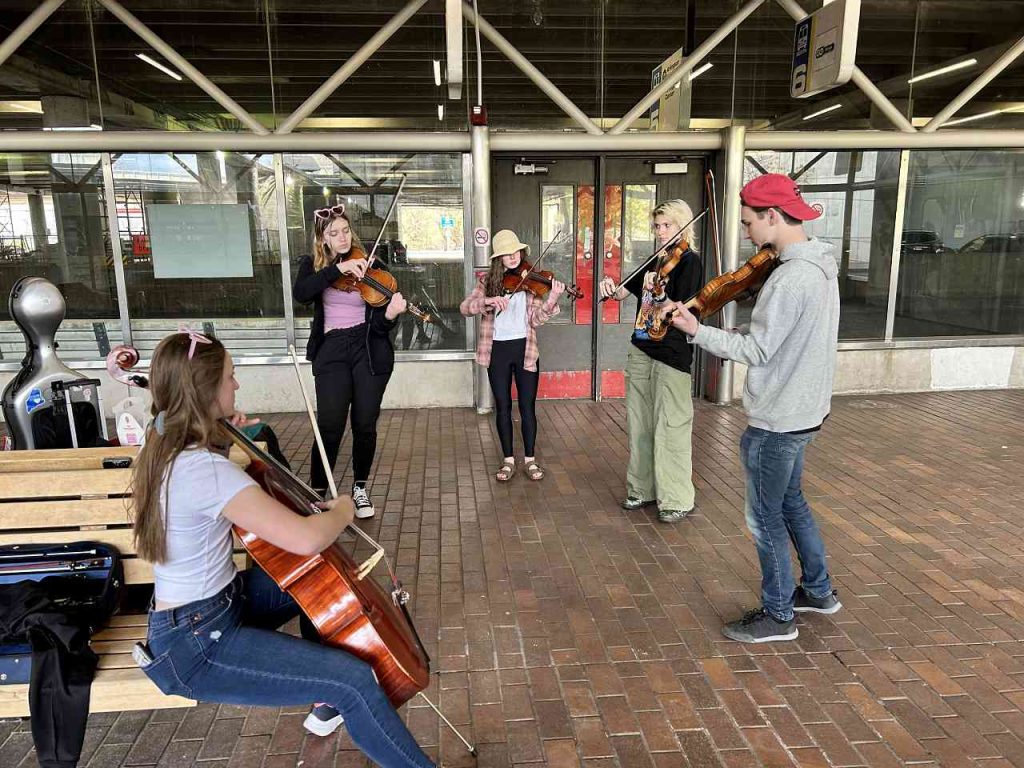
It sounded like a dream. . .a dream come true! The glass-walled bus terminal at Alewife Station in Cambridge, Massachusetts, resounded with the joyous sounds of youthful music making. The players were students from Maine, members of Capital Strings from the Pineland Suzuki School in Augusta. They were playing and improvising upon toe-tapping arrangements of music by the Danish String Quartet as they waited to catch the bus to New York City. The energy was infectious, and a small audience gathered to enjoy the music. Lori Scheck and Carlough Faulkner-Carroll greeted each other with giddy excitement. “We did it!” “This is actually happening!”
Sometimes inspiration hits like a thunderclap. You encounter something novel, and it changes your whole idea of what is possible. That’s the way people who saw Dr. Suzuki’s tour groups, or met and worked with him, describe the experience. And that’s what happened to Aimee Morrill Briant and Carlough Faulkner-Carroll when they first encountered the tour groups at the Suzuki Conference in Minneapolis in 2010. The students, who performed at such a high level and played with such joy and abandon, regularly traveled to other locations to make connections and perform with other Suzuki students. What an inspiring idea! Carlough and Aimee immediately began to work together to create an experience like this for their students. Several failed attempts later, they had to admit that organizing a tour group turned out to be much more difficult than they had imagined, a reality made more challenging by the fact that both Carlough and Aimee had started families and were homeschooling their children. They decided to set the goal of creating a tour group aside for a while.
Sometimes inspiration whispers through the window and invites you outside to play. In the spring of 2022, Betsy Kobayashi and Lori Scheck of Pineland Suzuki School in Augusta, Maine, contacted Carlough to inquire about a collaboration. They were planning to bring their tour group to Boston, and invited Carlough’s students to join them in a concert. This endeavor also failed to come together, but they all agreed to meet and talk about future possibilities when at New England Suzuki Institute that summer, and Carlough asked to have Aimee added into the collaboration. That is how the “dream team” was born.
In April 2023, the four teachers, along with students and parents from all of their programs, met in New York City for a four-day tour. The following is a round table discussion about how it all came together.
How did you get involved in this adventure?
Lori: Betsy and I had been trying to arrange a tour trip for our advanced students for a couple of years. Six students had been awarded the opportunity to participate in honors orchestras at the 2020 Suzuki Association conference. However, the trip had to be canceled due to COVID.
Betsy: We had promised the students a trip of some kind. They were fundraising and busking on weekends for travel funds. So, we planned a trip to Boston for February 2022. It was all arranged, with master class lessons, attending a concert of the Boston Symphony, and playing a concert at the Boston Children’s Museum. But COVID had another surge and we had to cancel that trip as well.
Carlough: Aimee and I run “sister studios,” both called Crescendo Suzuki Studio. I’m located in Massachusetts, and she’s in New Jersey. We have been finding ways to work together for years despite the distance. We’ve dreamed about combining our studios to go on a tour of this sort for a long time. When Betsy and Lori reached out to me for a collaboration, it was obvious that I should bring Aimee on board.
What made you choose NYC?
Carlough: It was serendipitous. Initially, I suggested it because I thought my students would be more excited about that than playing in the Boston area. I wanted all of the students to get an adventure out of this experience. Coincidentally, I took my daughter on a New York City trip in the summer of 2022. We stayed at a very nice hotel just blocks from Carnegie Hall, Lincoln Center, and Central Park.
Lori: While we had a preference for New York City, we actually looked for opportunities all along the eastern seaboard. We were hoping to find a performance for the students to attend. We’d identified a week that both Maine and Massachusetts students were on break, and we reached out to the Danish String Quartet (DSQ), Time for Three, and Black Violin to see if they might have a performance during that week. We were hoping we might arrange a coaching session for the students.
Aimee: Lori was amazing! She was as tenacious as a bulldog in sending nearly weekly correspondence to the agents of those groups, but we received no response.
Carlough: By August, we were discouraged because none of the performing groups were getting back to us. I decided to check the performance schedule at Carnegie Hall before giving up. Eureka! DSQ was scheduled to play during our planned week. That was the point at which everything began to fall into place. It really helped that I had been there recently and knew the lay of the land.
Betsy: Yay! This was an ideal scenario. The Pineland students are huge fans of the DSQ and have played many of their arrangements.
What inspired you to want to take the students on a trip, and what were you hoping to get out of the experience?
Betsy: The advanced students in our program are at a point where they need something really exciting and motivating. A trip to a big city, where great musicians from all over the world meet, would be so inspiring for them!
Lori: They all work so hard and sound so professional that I really wanted them to have the opportunity to perform for a bigger audience with students from other programs who share their passion.
Carlough: I was really excited to provide a rich (and challenging) experience for the more advanced students in my program–something that the younger kids can aspire to.
Aimee: Like the others, I wanted to provide an exceptional experience for the advanced students in my studio. Especially after COVID, they really needed something that provided a wow factor both socially and musically. I think, as a teacher, I also needed something to rejuvenate my energy and connect with other wonderful teachers, too.
How did you plan the trip?
Aimee: We connected at the New England Suzuki Institute in Waterville, Maine, in late June. Carlough and I met with Lori and Betsy during lunch to brainstorm.
Carlough: Throughout the summer and fall, we met monthly on Zoom. After the holidays, it became clear we needed to kick it into high gear to be prepared in time, so we decided to meet weekly. That meant we discussed ideas more frequently, and that the deadlines came closer together.
Lori: We discovered that our strengths are complementary. When one of us would reach the end of her capacity, someone else would take over the task. For example, I put together the first draft of all of the organizing documents for the trip, and Carlough edited and reformatted them to make them look professional. We discovered we all work together like a well-oiled machine! With weekly meetings via Zoom we were able to keep tasks on a timeline, communicate effectively, conquer every challenge as it appeared, and push each other to stay on task.
Betsy: Here’s another example: Aimee mentioned that she was having a hard time making phone calls during business hours while homeschooling her young children, so I took over those responsibilities. Later, Aimee took over the music-related student schedules when I needed to pass them on.
Aimee: Organizing three programs to meet in one new location, rehearse, connect, and perform in four days is no easy feat, and balancing that with our own teaching, families, and other pursuits during the year seemed daunting at first. Between the weekly meetings and splitting up the tasks according to our strengths, it became manageable. When one of us was extra busy at home, the others jumped in. By the end, we had all contributed to the planning of the trip without sacrificing family or energy for our own studios. In fact, having the trip to look forward to provided opportunities and excitement within our own programs!
Who went on the trip?
Betsy: Pineland Suzuki School’s most advanced performing group, Capital Strings, and Carlough’s and Aimee’s advanced classes were all similar in level (Book Five and up), so these combined groups were offered the opportunity to join this adventure.
Aimee: The majority of the group came from Capital Strings, but the Crescendo Suzuki Studios from Massachusetts and New Jersey had representation as well. Siblings were invited to play some of the easier arrangements in rehearsals and performances. Altogether, we had nineteen advanced students and six siblings involved.
Carlough: The students traveled with parents/chaperones, so our group ended up with about fifty people in all.
How did you fund the trip?
Lori: Pineland students had been fundraising for a few years. We arranged Sunday morning busking at a highway rest area. Not only were the donations generous, but the players received so much positive feedback from listeners! Donations were divided up between the students. We also sold raffle tickets for a wreath full of gift cards and cookies during our holiday concerts. One generous parent of a former student donated a large sum which helped to greatly reduce the cost for our students.
Betsy: For meals, travel to and from NYC, as well as local transportation, families were on their own. However, all of the fundraising and outside donations ensured that, aside from their deposit, Pineland families were able to pretty much go on this trip with very little cost. With fundraising, we were able to cover hotel and entertainment tickets as well as the concert tickets to the Danish String Quartet concert.
Aimee: My studio played spooky Halloween music at a trunk-or-treat event to make some money!
What happened in rehearsals? Outside of rehearsals? At performances?
Aimee: We had eleven hours of rehearsals in three days, and we had eight pieces of music to prepare for performance. It was an intense schedule. On the first day, we began with sectionals. The rest of our rehearsals were with everyone together. Much of our time was spent combining the musical interpretations of the three separate programs. Each teacher took on two pieces to coach. We worked on interpretation, storytelling, ensemble skills, leadership, and more. All of the pieces were student-led in the performances, with a main leader for the piece as well as leaders for each part. Most pieces were memorized.
Betsy: We are so grateful to School for Strings for allowing us to use their beautiful facility for rehearsals. It was ideal because our hotel was located a few blocks away. Also, some teachers from the School for Strings gave lessons to each student.
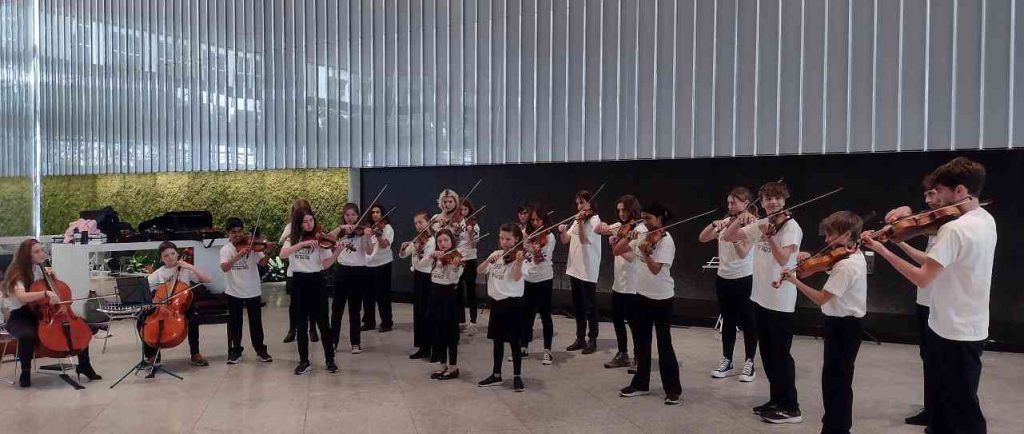
Carlough: We really wanted to find a place for the students to perform where they would have an audience in addition to their parents, and were inspired by videos of flash mobs performing in malls or office buildings. I found a website that detailed privately owned public spaces in NYC, and reached out to some of them to offer performances. We performed in the lobby of an office building on Friday at lunchtime. It had a beautiful backdrop with a floor-to-ceiling waterfall, and resounding acoustics. On Saturday, we performed at a busy mall overlooking Central Park. That performance attracted a large crowd. People would walk in, hear our music, and make a beeline for the escalator so they could see who was playing.
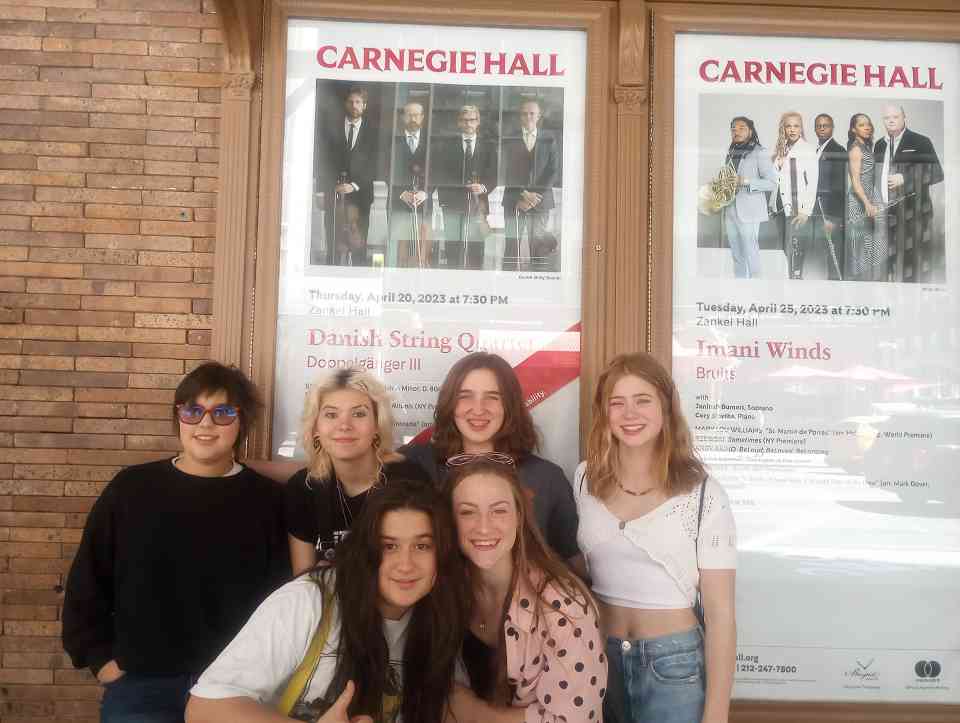
Lori: Outside of time playing our instruments, we arranged for a tour of Carnegie Hall, went to the Danish String Quartet concert, and on Friday, students and their families could choose between visiting Coney Island and the NY Aquarium or attending the Met Opera. Everyone had downtime to tour the city, walk around Central Park, enjoy meals within walking distance, and hang out with each other at the hotel.
What were some highlights or favorite moments on the trip?
Carlough: At the end of the first full day of rehearsing, the students were tired, and a little punchy. Four teenage boys lightened the atmosphere by swaying to “Country Dance” in an exaggerated manner. This totally changed the feeling in the room. Gradually, the other students joined in, and the room was energized! It was so fun that we ultimately decided to sway during that piece in our performance.
Betsy: I loved meeting the people at School for Strings and seeing their facilities, because I had heard of their great reputation for so long. The Met Opera was indescribably beautiful. It filled my heart, and inspired me so much as a musician and teacher. The music was so smooth with such beautiful phrasing. The softest pianissimos were delicate yet strong, and the loudest fortissimos were strong yet beautiful.
Aimee: Quietly observing the students during the breaks was heartwarming. They improvised, goofed around, supported each other, made new bonds, and much more. Every time we noticed a student having a hard moment, other students rallied around that child to make them feel comfortable. Our final performance was another highlight. I enjoyed both the students performing and the many audience members who either gathered expectantly or stumbled upon our group.
Lori: It was special watching small children dancing, clapping, and conducting along during our performance at a mall, but by far the most electric moment of the tour was experiencing the reaction of the biggest fan club of the Danish String Quartet (us!) when we found out we could meet the group backstage at Carnegie Hall and then actually talk with the quartet.
Can you tell us more about the DSQ experience?
Aimee: The Danish String Quartet performance was one of my favorite performances I’ve ever been to. There was one point in the concert, during the slow movement of Schubert’s Rosamunde Quartet, that Carlough and I looked at each other and mouthed “Did we really just hear that?!?!” Everything they played was stunning. The final programmed piece, which was commissioned for the performance, was riveting, involving a handmade and hand-cranked music box. It was an experience that exceeded my expectations and was all I could have hoped for as the focal point of the trip.
Betsy: The Danish String Quartet was superb, so much energy and tone that filled the whole room. We really wanted to meet them in person. Lori tried to contact them through several different avenues for many months before the trip. No luck. Somehow, I never had any doubt that the students would get to meet the quartet, so I kept trying to make it happen. The afternoon of their concert, we had a tour of Carnegie Hall. I asked our tour guide if maybe we could watch their rehearsal. He said, “No, they are in another part of the building.” On the night of the concert, I asked each usher I could find if we could meet them after the concert. “Your name has to be on a list, but you can ask.” Finally, Lori and I reached the backstage door.
Lori, who was silent up until this time, began bubbling over. “We have this group of twenty kids who love the Danish String Quartet so much and are here on a tour of New York City from Maine, New Hampshire, and New Jersey and are playing many of their arrangements and they really, really, really would like to meet them!” The person attending the door said she would ask. She closed the door and we waited. She said to come back at intermission, so at intermission, we tried again. At last they said, “Yes!” When we told the students, they were jumping up and down with excitement!
Carlough: What Betsy isn’t telling you is that she was just as excited as the kids. She squealed with delight when she came upstairs to tell us! The students went bonkers! They were so excited.
Lori: I had been frustrated with all of the many times I had reached out to the manager of the Danish String Quartet without getting a response, so I was really glad that Betsy was persistent!
Betsy: Each DSQ member (Rune, Asbjørn, Frederik, and Fredrik) was so friendly, laughing and joking with each kid, writing autographs, and having pictures taken. To hear the DSQ was definitely a highlight of the trip for all, but to meet them personally went way over the top!
What repertoire did you choose for the tour group?
Carlough: We chose some of our repertoire around the DSQ experience, so performed several of their arrangements and original compositions. We also performed some of the pieces from the Suzuki repertoire, arranged to have harmony parts at different challenge levels.
Betsy: Carlough is being humble here. She made some awesome arrangements of Country Dance and Bohm Perpetual Motion which were challenging and fun for more advanced students.
Lori: One of my favorite pieces was Carlough’s arrangement of the Star Spangled Banner. It was both challenging and exciting, especially for the more advanced students! It also had easier parts for the less advanced siblings who joined the trip.
What challenges did you encounter?
Lori: The lack of response from the performing groups we were hoping to connect with initially made it seem like the whole endeavor would fall apart. I, however, am not easily deterred.
Carlough: Once we were there, there was definitely a learning curve to figuring out how to help a large group of people navigate the city. We learned that it was best to allow each individual group to decide how they wanted to get around on their own.
Betsy: Finding a place to perform was definitely a huge challenge. We wanted to find a place indoors with lots of people passing by. We did also try to play at Central Park, but it was too busy at that time.
Aimee: We had to rework the student rehearsal, masterclass, and sectional schedule several times due to teacher and room availability. This created late nights and even last-minute adjustments.
What did you learn from this trip that would help you in organizing another in the future?
Lori: One thing we will do differently is to allow families to arrange their own leisure time. We tried unsuccessfully to have everyone go to Coney Island and the New York Aquarium as a group. However, different personalities enjoy different things and it was difficult to keep everyone “together.”
Aimee: I think planning the trip around a particular concert was a great idea, and worked well. We plan to use the same strategy next time. Something we would like to add in our next endeavor is organized social opportunities for the parents so they can connect to each other more easily.
What effect do you feel this trip had on your students? What inspired/motivated them past this experience?
Carlough: Several of my students had stand-out experiences in the master classes. I’ve noticed them continuing to think about the ideas they encountered. Also, each student was asked to lead a section at some point in our performance. That leadership has made a difference in some of the students’ personal sense of ownership and competence.
Lori: This trip strengthened the camaraderie in our program. The students gained a deeper understanding of how to communicate with gestures and how to watch each other closely while playing. This brought home a tighter, more expressive ensemble. One of my students who had been having serious doubts about his violin study decided to continue because he was so inspired by his leadership role in this trip.
Betsy: Ditto to everything Carlough and Lori said above! The swaying to Country Dance filtered down to a play-in we did in May back in Maine. The students who went to New York City were swaying to other pieces. They felt so comfortable and confident moving to the music. Their confidence in themselves as musicians and as people grew with the intense experiences of playing with new people and navigating in a new place. The lessons from their master classes continue to reverberate in their playing.
Aimee: I also have to mention the siblings who were able to play a couple of the pieces on the trip. The one younger sibling who attended from my studio announced at the end that he wanted to practice three hours a day so he would be ready the next time we organize a tour. He may have exaggerated a little, but he has not missed a day of practicing since he returned home, and his playing has become so mature in a very short time.
What do you feel you as teachers actually got out of this experience?
Carlough: The trip functioned just as I hoped it would. The students who went very much benefitted from the experience, and there is a buzz of excitement in my studio about similar ventures in the future. The surprise for me was the development of deep friendship among the four teachers involved. This has been the most amazing collaborative experience! The four of us can accomplish things together that I can’t do on my own, and that Aimee and I didn’t have the bandwidth to accomplish as a two-some.
Betsy: Seeing the lessons of School for Strings teachers (Alan Lieb, Sarah Geller, Kristen Krauss) and Joel Noyes and working with Carlough, Aimee, and Lori was refreshing and rejuvenating! Being with the students in real-life situations deepened my understanding and love for them. It all helps me be a better teacher!
Aimee: I felt I could bring a lot of great energy, repertoire, and ideas back to my studio. I also found so much inspiration from working with Carlough, Lori, and Betsy. We make a good team!
Lori: This project was so much work! Hours of planning, meetings, organizing . . . I would do it all again! A project of this magnitude takes many hands and many talents. Working with these three teachers makes me realize that any collaboration is possible with the right combination of people. I feel blessed to call them colleagues and friends. I am tremendously inspired by the students, who brought home a sense of leadership, a boost in confidence, and a desire for more! I am more determined than ever to provide opportunities for the advanced students of our program and their families.
What’s next?
Carlough: We were so energized and inspired by working together that we’ve continued our weekly Zoom meetings after the trip. I look forward to seeing these three friends every week!
Betsy: We excite each other with our dreams and ideas, such as a shared desire to have a bigger event for New England’s advanced Suzuki students or seeing all of the Suzuki kids from Maine on one stage.
Lori: We are planning a short Boston trip for the upcoming school year. Some other interesting opportunities and ideas arose from this trip and we hope to do something of this scale every few years. This is only the beginning!
Conclusion
A week after their return from New York City, the four teachers were once again gathering for their weekly Zoom meeting. “Let’s just read through the surveys and see if we have anything good!” said Lori as she opened up the exit surveys. At first, there were several complaints about trivial issues or annoyances people had encountered. The foursome began to feel discouraged until they came across this comment from a student:
This trip drove home the point that music really does bring people together. The “universal language,” the “voice of God,” whatever you believe, music has given me so many friends that I otherwise probably wouldn’t be able to get along with. When four teens walk hand in hand, identifying as a Gender Fluid Goth, a Lesbian, a Christian, and an Atheist respectively, that shows how beautiful the bond of music-making can be.
One could not ask for a better affirmation of the immense and long reaching value of this trip.
This team of teachers hopes to inspire other teachers to go for their dreams, whatever they may be! An ambitious project, similar to ours, is achievable with the right combination of people, ideas, and ambition. Our Suzuki community thrives on teachers connecting, invigorating, encouraging, and influencing each other. That’s why Suzuki teachers gather together at workshops, institutes, festivals and conferences.
The vision for this amazing experience was stirred by Dr. Suzuki and his love for all children, the beauty of the mother tongue approach, and the environment of cooperation which Dr. Suzuki inspired among teachers of his method around the world. The echoes of his influence are still reverberating.