 EN
EN  ES
ES  PT
PT  FR
FR 
A Lifetime of Service: An Interview with Marilyn O’Boyle
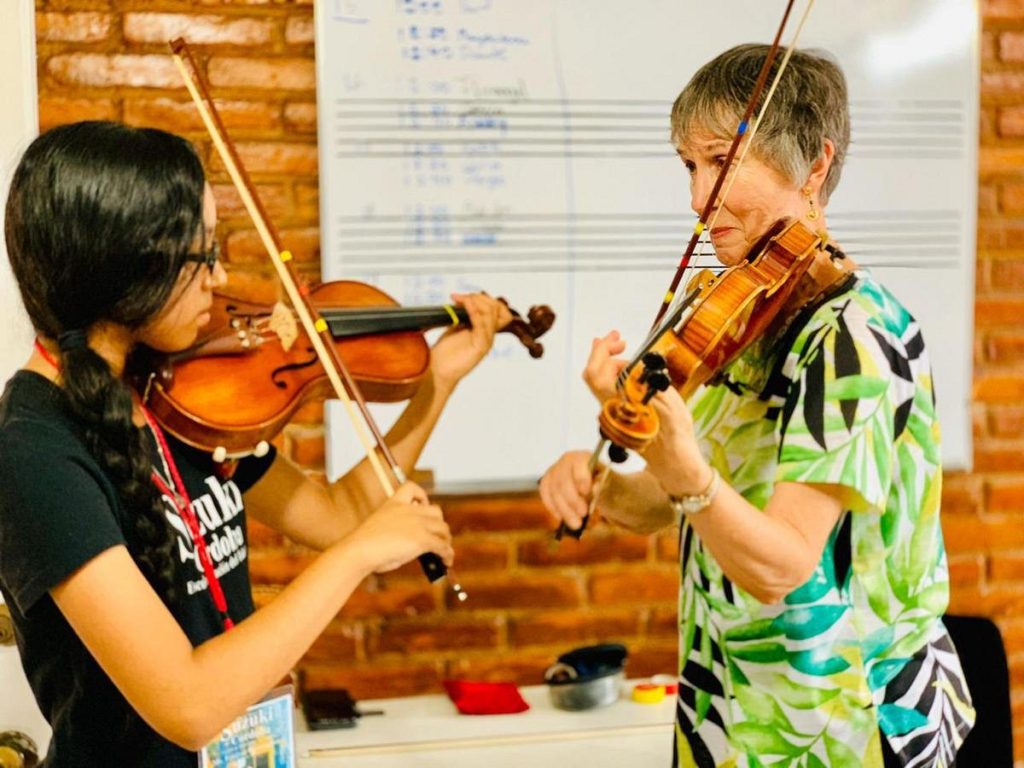
Few Suzuki teachers haven’t been affected by the work of Marilyn O’Boyle. She wrote two staples in Pre-Twinkle repertoire, which have been adapted and used in countless studios across the Americas. Her tireless work has benefitted the Suzuki movement in Latin America. For me, Marilyn’s influence goes past the repertoire, deeper than Latin America, and even closer than her contributions to our shared town, Albuquerque. Marilyn is an honorary member of our family.
Marilyn was my husband’s teacher for all of his childhood and teen years, taking him from fragile foundations into concertos. After 10 years of marriage, we still often discuss Marilyn’s teachings. When I have a struggle with a student, Cameron would remark, “This is what Marilyn would do.” When I have success in the studio, he would reminisce “Oh yeah, I loved when Marilyn did that.”
Marilyn recently announced her retirement after a long career championing Suzuki education across the Americas. When Marilyn wrote to us announcing her retirement, Cameron and I both were broken-hearted. She graciously allowed me to interview her as a memorial of her service to the Suzuki community and her impact on our family.
Tell me about your childhood and beginning on violin?
I grew up in Albuquerque, New Mexico, and started piano lessons at about age six or seven, but fell in love with the violin after hearing Efrem Zimbalist play “The Hot Canary” on TV. I begged my parents for a violin for about two years. They finally borrowed one for me, and I enrolled in the sixth-grade after-school orchestra program. It was a rough start with no individual instruction, and I just about gave up, but the junior high orchestra teacher talked me into continuing. I got more and more involved and took private lessons with her as well. I had several teachers after that, and I usually paid for my lessons by being the accompanist for the teacher’s other students. By the time I was in high school, I knew violin was going to be my life’s focus, thinking of a career as a performer first of course, but soon realizing (and enjoying) playing in orchestras and teaching.
When and how were you introduced to the Suzuki Method?
When I was playing in the Amarillo Symphony in about 1964, one of the bass players took a weekend course about the Suzuki Method with John Kendall and came back wanting to start everybody’s four-year-old on violin. So, our oldest started with him for about six months. This daughter is now the violin professor at Tulsa University and concertmaster of the orchestra in Tulsa, so something stuck!
Suzuki’s ideas kept rolling around in my head for a few years and I finally went to Stevens Point, Wisconsin, in 1972 and got some training. We moved to Lincoln, Nebraska the next month after the course, and I was an ‘instant’ Suzuki Violin teacher! I returned to Stevens Point full of questions, year after year, watched all the Starr videos, and learned so much from the great teachers there during that time. For several years, I took my kids there and finally was part of the faculty. I also took several workshops and read everything I could about the Suzuki Method. Training was not nearly as organized and structured then as it is now! I almost immediately had a studio of about 30-35 kids, including my five children. All my children have since become professional musicians, and a couple of my nine grandchildren have embarked on musical careers as well.
I got my Bachelor of Fine Arts at the University of Nebraska and started a Suzuki Pedagogy program there in 1978, shortly after becoming a Teacher Trainer. There were gradually more teachers, and we started the Lincoln Talent Education Association and started summer ‘Suzuki Camps,’ which eventually included teacher training classes.
After 10 years in Lincoln, my husband at the time, Robert O’Boyle, an oboist and band director, wanted an adventure and was interested in teaching in another country. So, we were off to Latin America! He taught at the American School in Lima, Peru, while I started a Suzuki training program there. I met my dear friend, Caroline Fraser, and we started the Peru Festival in 1983. Caroline and I traveled together for the First International Suzuki Conference in Matsumoto that same year.
After that, I had adventures teaching courses in Peru, Chile, Bolivia, Argentina, Paraguay, Costa Rica, El Salvador, Guatemala, Colombia, Mexico, and Brazil. I also got my MFA in Violin at Texas Christian University. All five of my children were involved in my Master’s Recital, as we played the Mendelssohn Octet with seven of the eight players being O’Boyles or related!
Many know you from your contributions to Pre-Twinkle repertoire. Can you tell us about how those songs came to be?
Evy Olson was the mother of one of my first Suzuki students and was very dedicated and creative. I had mentioned the importance of teaching in small steps and was teaching her daughter, Wendy, some little segments of Twinkle. Between the two of us, we came up with words to these little steps, and Flower Song and Monkey* Song were born. Evy later became a Suzuki piano teacher, and both of her daughters, Wendy and Jill, are professional violinists.
[size=90]*Note: Because of the racial connotations behind the word “monkey,” many teachers have appropriately altered the words and title to be culturally sensitive.[/size]
You’ve made significant contributions to the Suzuki Method both at home in Albuquerque, New Mexico, and in South America. Can you talk about your contributions in both places?
I was very fortunate to have been in on the beginnings of the Suzuki Movement in the United States and to have had the opportunity to learn from the pioneering teachers who studied with Suzuki in Japan. Teaching my own children and teaching so many teachers and students in Nebraska for 12 years helped me hone my skills while also being able to continue learning from other teachers in that “Suzuki-rich” area of the country. The experience of teaching in two Latin American countries in the 1980s was also very fortunate. I think it was important for Teacher Trainers to be there to introduce and develop the Suzuki Method there, and to establish the Suzuki Festivals which are modeled after the Summer Suzuki Institutes that happen in North America. From the beginning, we have worked to keep North American and Latin American programs operating out of the same basic principles and design. I took two years of Spanish at the University of Nebraska, as a part of my degree requirement, not realizing how handy it would be to know this language. I have been on the Board of Directors of the SAA two different times, and I think I have been able to add a perspective to the discussions because of my experiences in Latin America. I have also established and directed several Suzuki Institutes, starting in Lincoln, Nebraska and after moving to Albuquerque, I established and directed the New Mexico Suzuki Institute for 10 years. Other than that, I have been very proud of the accomplishments of all my students, whether or not they have continued playing. We have had so many wonderful years together!
What were the circumstances that led to your retirement? What are you looking forward to in this next chapter of your life?
In early 2020, retirement was not really a part of my life plan. But I experienced severe hearing loss last August, so besides dealing with the lock-down and the pandemic, I had to figure out how to go forward with my life. Luckily, much of the problem gradually resolved itself, and I can hear language with the help of good hearing aids. However, I have ‘pitch distortion’ on the higher notes of the violin, so it was a big challenge teaching online training courses in 2020 and early 2021. After the last course in February of this year, I decided to stop completely and let others continue doing this great work. I have been through a real grieving process, as I give up not only my long career but also my enjoyment of playing and listening to my chosen instrument. I am healthy and strong and am looking for ways to serve the world, especially concentrating on social justice and climate change. I miss seeing all my Suzuki friends and colleagues, but I have decided to live with gratitude for the life I have been given.
What do you feel are the most important lessons from Dr. Suzuki?
I think his real genius was linking language learning with music learning, applying the same dynamics of learning your ‘mother tongue’ with the tools of teaching music (or any other subject!). Out of this comes the importance of early beginning, creating a musical environment, listening to the music, parental involvement, repetition, positive approach, step by step mastery, learning at each child’s own pace, and all the rest. He had the gift of noticing this important connection between language and music. He applied this insight in his teaching and writing, woke all of us up to it, and showed the world the fantastic potential of young children. We must also remember that his goal was never to make professional musicians, but to help each child reach their potential and become what he called “a good citizen” or a person with “a noble heart.” We have indeed been blessed by his presence in our world!
As a Suzuki community, we congratulate Marilyn on a full career and thank her deeply for all her contributions. As a partner to a direct product of her work, I can very personally testify that Marilyn did raise “noble hearts.” We all look forward to seeing the contributions she will continue to accomplish to make the world a better place. Thank you, Marilyn.