 EN
EN  ES
ES  PT
PT  FR
FR 
The Benefits of Planning Ahead
Preparatory Exercises and Piece Previews in Suzuki Guitar
By Jim Rickevicius
As Suzuki teachers, we have the advantage of knowing the essential repertoire a student will learn as well as when most skills will be taught. The more we experience teaching the repertoire, the more we can also predict which skills need extra time to set up and which pieces have particularly hard passages that might benefit from exposure well before encountering them in a new piece. Keeping this in mind, I have noticed that some of the most effective teachers start to prepare a student for upcoming challenges ahead of time. This leads to more enjoyment of the learning process by the student, parent, and teacher. This is often achieved by using preparatory exercises and piece previews as early as possible for upcoming skills.
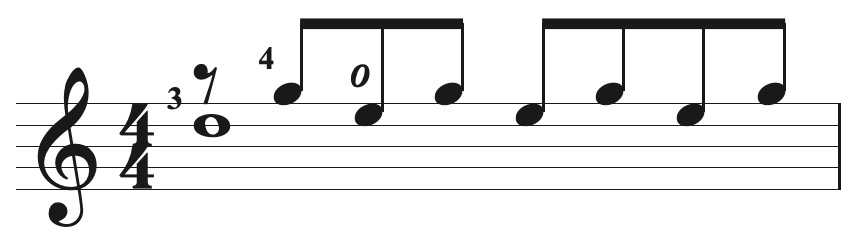
New technical skills are often introduced with a preparatory exercise. The exercise depicted in Example 1, nicknamed “pinky push-ups,” would be for the development of the fourth finger ahead of its first use in Song of the Wind, the fourth piece in Suzuki Guitar Book One. For this exercise, the third finger remains placed on the second string D to keep the left hand stable and balanced while the fourth finger curls to fret the G note on string 1. As the fourth finger gains coordination and strength, proper positioning is developed without moving the left hand itself.
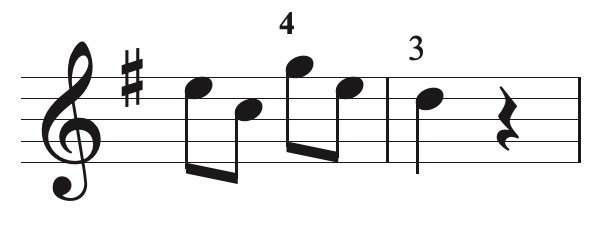
Sometimes, a piece contains a particularly difficult passage that a student may struggle with, often containing a newly learned skill. Teachers will often teach a passage like this before starting the piece itself. This is called a “piece preview” and allows the student some time ahead of starting a new piece to get used to the passage and for the teacher to make sure the student is achieving a high standard of excellence with their technique. Continuing the example of Song of the Wind, the following five-note passage uses the fourth finger and takes some getting used to at this stage.
Knowing the challenges that the Song of the Wind example presents to beginning students, teachers can start to work on the above exercises well before the student reaches Song of the Wind so that the student is well prepared for success before the piece is even started. In this particular example, I would start this process soon after Twinkle is well learned since the two pieces following Twinkle offer more of a reinforcement of the skills learned in Twinkle. I would start with the exercise first and, when the student’s four-finger placement was ready, I would then add the piece preview as part of the student’s warm-ups along with the tonalization in G Major below (ex. 3). I have found many benefits from planning ahead in this way.
Planning ahead can help students experience a more seamless feeling of progress throughout their learning.
The Feeling of Steady Progress
Assuming the components of the Suzuki environment are present, planning ahead can help students experience a more seamless feeling of progress throughout their learning. When students are just beginning their journey with an instrument, there are many pieces to put into place to set the student up for success. For Suzuki Guitar, there are upwards of twenty-five small, attainable skills that beginning Suzuki Guitar students learn in order to play Twinkle, Twinkle Little Star. Each skill can be broken down and taught in a way that develops a high standard of excellence so that when the student puts everything together, they have established a pattern for good playing technique. This process naturally takes time when done well. As Suzuki mentions in Nurtured by Love, “the beginning will be slow until the bud of ability takes hold.”

These beginning steps require patience and persistence on the part of the parent and student since the result of their work may not be initially apparent. Once Twinkle is learned, new skills are generally introduced in a more gradual fashion; however, the same attention to detail and proper development should be fostered. Since there are pieces in the repertoire that are more reinforcement pieces rather than pieces that introduce a new technique, teachers can work on the thoughtful development of new skills while students are learning the pieces that have a more reinforcement quality.
Continuing with the example from Song of the Wind, students generally progress pretty steadily through the second and third pieces of Suzuki Guitar Book One. If they have been spending time developing their fourth finger as they learn those two pieces, it is often well-developed by the time they need it for Song of the Wind, so that learning Song of the Wind feels no different to them even though it presents a new challenge. In fact, if they have worked on their piece preview for Song of the Wind, the piece may seem easier to learn when the time comes to start it.
Increased Motivation and Enjoyment
As you can imagine, it can be motivating for a student to feel as though they can steadily progress through pieces instead of having to wait until they are ready or move ahead with a less than efficient technique. Although learning how to approach and successfully meet challenges is an expected part of learning an instrument, when challenges seem too far out of reach, students can feel frustrated and “stuck,” which can affect the feeling of accomplishment they may otherwise experience. By working on challenges in the exercise and piece preview section of their lessons, teachers can set a pace that works for each student without holding up their progress because they are not prepared. I have found that when students are feeling challenged by a new technique that is not part of the piece they are currently learning, they are able to approach the challenge more productively.
Focusing on Standards of Excellence
When teachers start working on a technique well ahead of needing it, there is time to develop the technique properly and get lots of repetitions that are supervised by the teacher. Students can then be allowed to do this at their own pace without it affecting their progress. Time can be taken to ensure that the student’s foundational technique is strong since when a new technique is introduced, it is an opportunity to revisit foundational skills. They can also sit with the new technique for a while and develop proper muscle memory and ease of execution so that when they need it, the technique will serve them well and they are more free to enjoy using it in a new piece.
Tone
I usually work on preparatory exercises and piece previews right after tonalizations at the beginning of the lesson. Placing them there catches the student when they are fresh and focused. It also helps to apply the tone we just worked on to the new skill when the student is ready. Since the technical component of the piece has been worked on extensively, the student is more able to concentrate on tone as they are first learning the piece.

An example of planning ahead in Suzuki Guitar Book Two that I use is the development of free stroke technique. Well-developed free stroke technique is essential to a guitarist’s progress and development from mid-Book Two on. For this reason, I usually start teaching the technique soon after a student begins the book. I take a good amount of time to establish the basic free stroke position and technique using just strings 2 and 3, as shown in the first note of example 4. Once that is established, I use the entire tonalization in example 4 to further develop the technique. This example also serves as a bit of a piece preview as it contains chords used in the first two free stroke pieces.
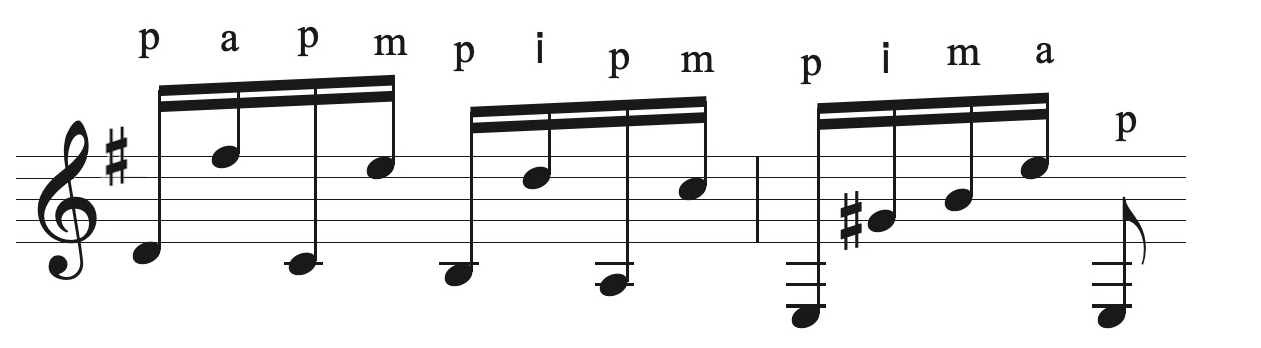
Ferdinando Carulli’s Andantino in Book Three contains passages like the one shown in example 5 where free stroke technique, good control of right-hand fingering, and the ability read all six strings in first position must all be well established. Students can become frustrated trying to learn the more complicated passages contained in this piece which are among the most difficult in the repertoire up to this point. By learning the passage in ex. 5 as a piece preview along with the other five like it, students can learn the piece as they have any other piece and enjoy the benefits of including it in their repertoire.
I encourage teachers to try to plan ahead in this way with their teaching. Talking with other teachers and taking continued teacher training can also give perspective on some of the more challenging skills and pieces that require preparation. The more experience one gets teaching the repertoire, the more opportunities one will find to prepare students for what lies ahead.

Jim Rickevicius is a classical guitarist based in Hartford, Connecticut. He earned a master of music degree in guitar performance from the Hartt School of Music, where he has taught Suzuki Guitar for the school’s Community Division since 1996. He has been the guitar coordinator for the Hartt Suzuki Institute since 2004 and also teaches at The Loomis Chaffee School in Windsor, Connecticut. Outside of teaching, Jim enjoys spending time with his wife and two sons.