 EN
EN  ES
ES  PT
PT  FR
FR 
Suzuki Association of Utah’s Parent and Teacher Convention
I came home from the Suzuki Association of Utah’s Parent and Teacher Convention completely exhausted, and also completely energized to teach again the next week. The theme was Connecting Utah’s Music Communities, and I loved how the keynote speaker and nearly all the break-out sessions were taught by local music teachers and specialists.
One of the first sessions was about Dalcroze Eurhythmics, presented by Mira Larsen, who runs the Rhythmique Music School in Salt Lake. I didn’t know anything about Dalcroze when I went into her session, but I loved that it was so interactive. She would have us do the activities, and then explain the pedagogy behind it, which continued to build my excitement for the next session. I also enjoyed the session that Marcus Hardy taught about Difficult Conversations. Clear communication isn’t always my strong point, so it was good to relearn and reinforce things I’ve learned before but possibly forgotten. Marcus is also a fantastic teacher, so the session was fun and engaging.
The keynote speaker was Lucas Darger, the conductor of the Southwest Symphony in St. George. He explained how he’s been building the Symphony and its outreach programs for the past eight years, and the amazing results he’s been able to have. It was so inspiring for me, as building a music program can sometimes feel thankless.
From there, I popped into the Kodály class by Logan McKinney. Although I don’t have a background in Kodály, I had heard so much about him and wanted to see what it was all about. Like the Dalcroze class, Logan would have us sing or participate in an activity, and then explain the pedagogy being taught. It was fantastic to experience this introduction to Kodaly with other Suzuki Teachers–we couldn’t stop talking about the connections between the two methods.
My next session was taught by Dr. Jon Skidmore from Brigham Young University, specifically on how to address stage fright and performance anxiety. This class, which was based on psychological research, contained many interactive elements. Someone in class would sing, and then do the things Dr. Skidmore suggested in his demonstrations. Their tone and sound became much stronger. I loved the way we could see these principles in action.
Perhaps my favorite session was taught by BriAnn Christensen, a Suzuki piano teacher and the President-Elect of the Suzuki Association of Utah. She used concepts from a book Dan Sullivan and Benjamin Hardy’s book The Gap and the Gain to illustrate ways the Suzuki Method can work in your family, even if you aren’t in what Dr. Suzuki would have envisioned as the ideal musical environment. A big part of this has to do with how we measure success. As BriAnn put it, “Most people, especially highly ambitious people are unhappy because of how they measure their progress. We all have an “ideal,” a moving target that is always out of our reach. When we measure ourselves against that ideal, we’re in the Gap. However, when we measure ourselves against our previous selves, we’re in the Gain.” While I realize that I’ve improved as both a Suzuki parent and a Suzuki teacher, I’d never looked at how I measured my progress this methodically before.
The SAU Parent & Teacher Convention is always a great way to renew your energy during what can be a hard time of the year. Come join us next year!
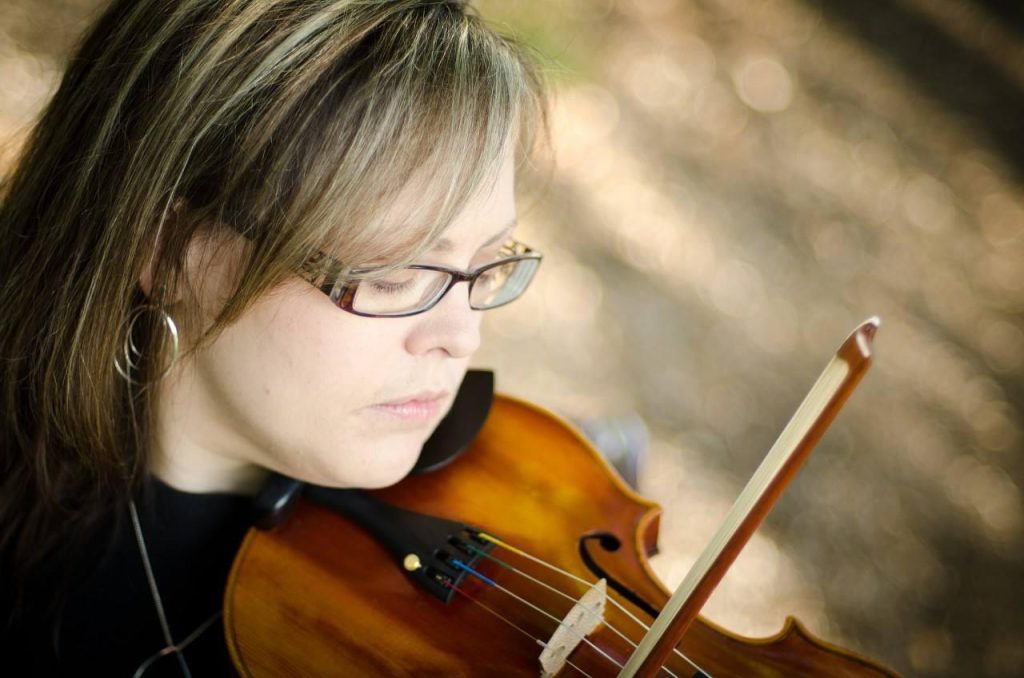
Nicole began as a three-year-old Suzuki student, studying with Hiroko Primrose. She then began teaching at 14, and moved on to graduate from the University of Utah. Recently, Nicole served as President of the Suzuki Association of Utah. In addition to running a large violin and viola studio, she co-directs Utah Peaks Players, a student performance group. When she’s not teaching, Nicole enjoys reading and spending time with her husband Robert and their five children.