 EN
EN  ES
ES  PT
PT  FR
FR 
Student Corner: Music Through the Eyes of Suzuki Students
By Kylie Hayter (age 13) and Ellie Yan (age 14)
We would not be where we are today without the Suzuki Method. Our names are Ellie Yan and Kylie Hayter and we are students at the Western Kentucky University String Academy. We are thirteen and fourteen years old, and both of us studied the violin through the Suzuki Method. It is impossible to describe the substantial opportunities this Method has offered. It has helped us gain performance/event opportunities, change our perspective on life, overcome challenges, and deepen our understanding of music. Here are a few of the many experiences the Suzuki Method has offered us.
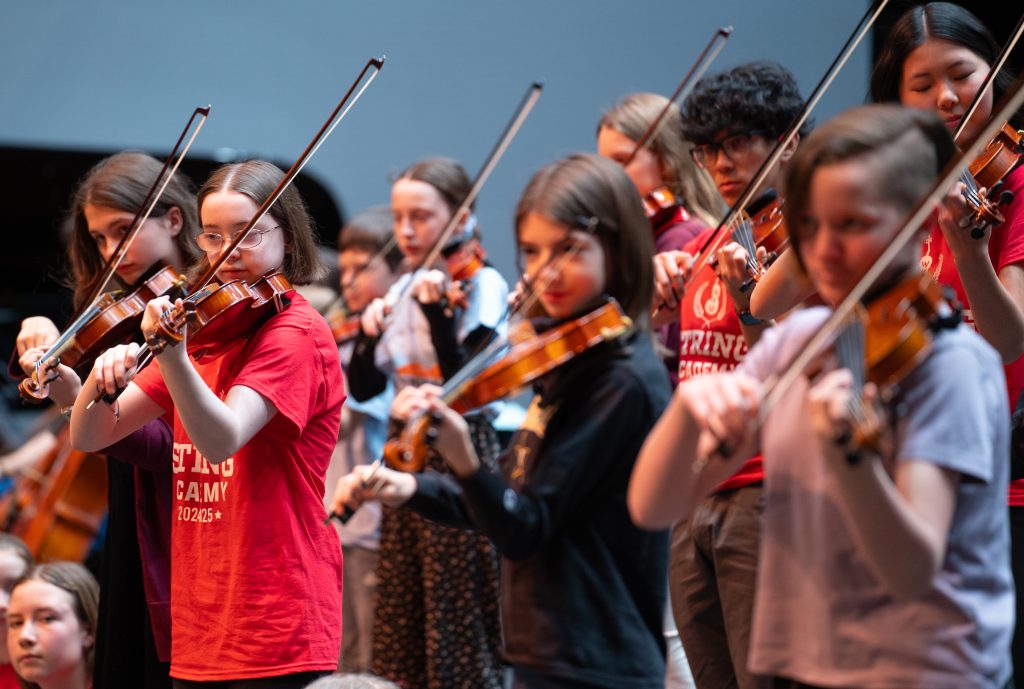
Kylie: When I first began playing the violin in third grade, my teacher introduced me to the Suzuki Violin Method. While I didn’t know it at the time, I quickly learned several pieces that I would carry with me for the rest of my career, including some of my favorite pieces to this day. My foundation as a Suzuki student has helped me advance both in my technical abilities and my musical maturity.
Shinichi Suzuki was not only one of the greatest violin educators in the classical music world, but he was also a notable humanitarian and philosopher. He once said in his book Nurtured by Love, “Perhaps it is music that will save the world.” Therefore, it is the obligation of musicians around the globe to share their artistry with others and to spread the joy of music. In this past academic year, I have worked on a number of pieces that I have grown to love, such as Bruch’s Violin Concerto in G Minor by Max Bruch and Introduction and Rondo Capriccioso by Camille Saint-Saëns. Without Suzuki, I couldn’t have gotten to where I am.
Ellie: I vividly remember walking into my first lesson when I was twelve years old. I was tense and nervous, as it was my first time being introduced to the Suzuki Method. It was all a new concept to me. However, my nerves soon eased and my teacher welcomed me with open arms. That afternoon, I returned home with Suzuki Book One in my hands, excited to start my Suzuki journey. I didn’t know it then, but this journey would prove to be one of the most crucial parts of my violin career. It gave me a wide repertoire that I could carry for the rest of my life and helped prepare me for the challenging pieces to come.
Shinichi Suzuki once said, “Musical ability is not an inborn talent but an ability which can be developed. Any child who is properly trained can develop musical ability.” Suzuki firmly believed that musical ability was the result of hard training, not talent. This quote means so much to me because it proved that it was not too late for me to start the violin. Through guidance and hard work, I managed to study four volumes of the Suzuki Method in one year. These pieces greatly inspired me to play on a more challenging level and became some of my all-time favorites. Two pieces that have especially stuck with me are Humoresque and Vivaldi Concerto in A Minor, and I’ve enjoyed learning Kreisler’s Praeludium & Allegro and Bach’s E major Partita in the past year. I can honestly say that without the Suzuki Method, I would not have been able to enhance my playing as much, nor play any of the pieces that I am capable of playing now.
Kylie: One of my most memorable performances this year was at a local nursing home on Valentine’s Day. I prepared several pieces that fit the theme of the event, including “Romance” from The Gadfly by Dmitri Shostakovich, Meditation from Thaïs by Massenet, and others. I learned the pieces very quickly, and I had lots of fun seeing the joy on the residents’ faces as I performed.
Ellie: As a Suzuki student, I’ve been offered many performance opportunities that I would not have gotten otherwise. One of these opportunities was the Suzuki Playdown at Vanderbilt University. This performance challenged my ability to memorize and pick up music quickly. We played pieces from Suzuki Book One to Book Seven. In just a few weeks, I revisited and reviewed fourteen pieces! However, even with the stress of preparing everything in time, I had a great deal of fun at the Suzuki Playdown and made many new friends who share the same love for music.
My background as a Suzuki student has changed my perspective on many things that will carry into my future. It has taught me that anything can be accomplished with practice. Suzuki believed that with consistent practice, anything can be achieved. However, this process is gradual and does not show immediate results, highlighting the importance of the learning process. All results are the outcome of hard work and practice, and nothing is too far out of reach with practice. This does not just relate to violin, it can be taken into and applied to life.
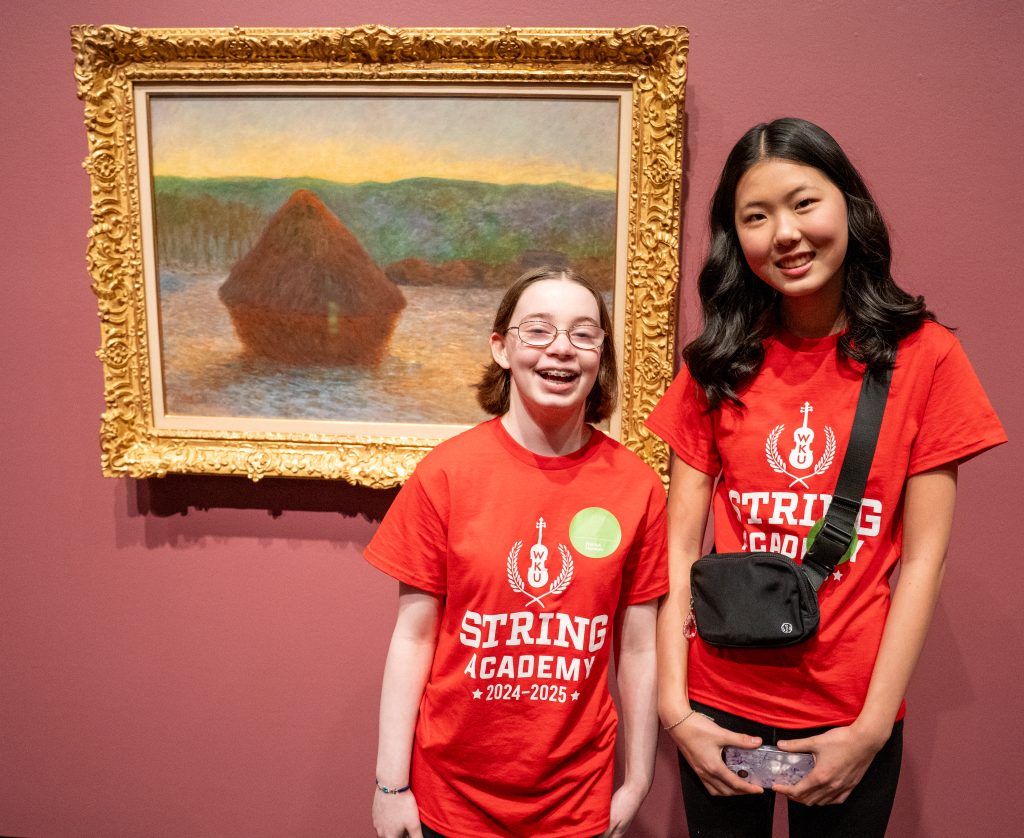
Kylie: Throughout my time as a violinist, I have experienced many challenges that have transformed me into the person I am now, both musically and otherwise. One challenge from quite recently was due to a concerto competition I participated in a few months ago. I had found out that the winner of the previous year, an outstanding violinist, was going to compete again this year, and I had completely psyched myself out by listening to his YouTube and Instagram recordings. When it came time for the competition, my nerves spiraled out of control, and when I didn’t place, I was convinced I was a terrible violinist. Since then, my nerves have gotten worse, so much that I’ve started shaking when I get on stage. Eventually, however, I began to realize that the real challenge was never the competition itself, but how I decided to let it affect me. It was never about how well I played for a certain competition or recital, but rather learning to accept that I will advance differently than my colleagues and that I shouldn’t compare myself to others. All anyone can do is try their best and recognize their limits.
Ellie: The Suzuki Method has helped me overcome many of the challenges I’ve faced throughout my violin career. One of the main obstacles I’ve faced is the stress of getting pieces prepared in time. Last month, I had two weeks to polish Bach’s Gavotte en Rondeau for a performance. At the same time, I also had many youth orchestra pieces to learn and practice, and also a piece for my group class. I didn’t think I could get it all ready in time. Despite this, I ignored my doubt and kept showing up to practice, because as Suzuki once said, “Only practice with much repetition will solve the difficulties.” I followed Suzuki’s quote and trusted in the process. It turned out to be a success. This quote by Suzuki helped me prepare for my performances in unimaginable ways.
Kylie: Music is a beautiful mimic of human emotions, and it has been the main focus of my life ever since I first discovered the violin. Every time I get the privilege to play music with my friends, I feel a joy that nothing else can compare to. For a lot of people, music becomes a chore. They forget about music’s most important aspect: love. And one day, their music may stop reflecting their emotions. When they are angry, they turn to hurtful words instead of music. When they are sad, they begin to view the world without color, and are stuck in a lonely void of monotone life. And when they are happy, they forget to share what they are feeling with the world. Without music, we can no longer touch hearts. We can no longer be human.
Ellie: Music allows for deeper connections among people. This deep connection is what allows music to express emotions in ways words can’t. Through phrasing and shaping, musicians can easily depict the underlying message a piece and send it to the audience. I undoubtedly believe that music is one of the most effective and emotional forms of communication in the world that helps people understand each other better on a deeper level.
In the end, music is a powerful language. When words and actions fail, we can use music to express the most complex emotions known to humanity, emotions that we ourselves may not be able to fully recognize. We would like to thank Dr. Ching-Yi Lin, the WKU String Academy, and the Suzuki Method: we have come to understand that music is not just about the notes, but about the people it affects. Should we forget its true meaning, we would lose a beautiful sense of identity and creativity.