Skip to Navigation

MaryLou Roberts

View Author Profile

Articles 1–12 of 12

April 4, 2012 / Topics: /

Reprinted from Soundboard magazine, Volume XXXVII, No. 3, 2011, pg. 42-47, with the kind permission of the Guitar Foundation of America

Angela walks confidentially to center stage, wearing her best concert clothes, carrying her prized guitar with her right hand low on the neck and close to her side. She responds to the audience’s applause with a smile and a deep bow before sitting on an adjustable stool and propping her left foot on a footrest. Almost without pause, and without a trace of anxiety or self-consciousness, Angela begins to play “A Toye,” an anonymous Renaissance lute piece with an engaging melody and a simple, but effective supporting bass line. The tone she produces is focused and beautiful, she plays with expression and mature phrasing, including a masterful ritardando at the end of the piece. The audience response is immediate and enthusiastic; Angela stands, beaming, and takes another bow before skipping off stage. Angela is seven years old—she has been playing the guitar since age three.

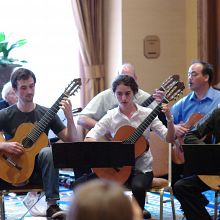
Angela is not so unusual—she is one of a growing number of children throughout the United States who learn to play the guitar through the Suzuki Method, the marvelous early childhood approach to teaching music that focuses on ear-training, developing good instrumental technique and producing a beautiful tone before introducing the complexities of music reading. What if young guitarists grew up with a solid technical framework from the beginning, without excess tension, using nails to produce tone, all with the support of a group of peers, parents and a network of teachers? What if those students and parents attended guitar concerts, played in masterclasses and listened to numerous recordings of guitarists. What if there were guitarists who grew up playing in ensembles, accompanied violins, flutes, cellos, and felt at ease and confident on stage? This is the idea behind the Suzuki Guitar Experience.

Read more of The Suzuki Guitar Experience »

25 Ideas to Involve Parents in the Suzuki Experience


ASJ 39.4, page 65

August 12, 2011 / ASJ 39.4 / Topics: /

Leadership Retreat Wrap-Up

S—T—R—E—T—C—H

It’s been a long time coming. I hadn’t even considered the possibility that I might be one until relatively recently. And to actually take on the role and don the mantel, to embrace the responsibility was like diving into the ocean—breathtaking and frightening at first, but finally invigorating and refreshing. A leader was emerging.

I wasn’t drawn to leadership. In fact, I spent most of my elementary years observing, only participating when called upon to do so. Perhaps it stems from growing up in a large family of mostly older siblings. I loved school, though, and thrived in an environment where I was constantly challenged to learn new things. Shortly before high school graduation, I inadvertently stumbled upon a college recommendation letter that my principal had written for me, one which I was not supposed to see. I did not resist the temptation to read it. He spoke highly of me except to say that I did not exhibit leadership capabilities. The slight stung at first, but over time, I reconciled myself to my perceived lot in life as the perennial support person. It was a comfortable place, and I relished the ease of it.

Read more of Leadership Retreat Wrap-Up »

June 13, 2011 / Topics: /

I have to admit that before I attended my first conference, I wasn’t sure why everyone was so excited about it. My colleagues thought it was one of the most important Suzuki events for a teacher to attend, saying you get to refresh and deepen your understanding of Suzuki ideas, see people who are leaders in different parts of the country, listen to inspiring speakers, and just get excited about teaching. So I left my children, ages three to thirteen at the time, with some serous “Daddy time” and drove to Cincinnati. I went on trust, and hoped for the best.

I had to do everything for that trip in the same way that I always do: making it the most fun without spending too much. Here are some tips for attending conferences on a budget. These ideas are for implementing now or in the fall.

Read more of Attending a Conference on a Budget »

Remembering Frank Longay

, ,
ASJ 39.3, page 61

December 13, 2010 / Topics: /

How can the SAA help increase the racial and ethnic diversity of students and teachers attending institutes and conferences?

  1. Diversity begins in the studio of each teacher. Encouraging families that are less fortunate or with different cultural backgrounds can be handled on many different levels.

Read more of Ask the Experts #18: Diversity »

December 6, 2010 / Topics: , /

How can the SAA help us to create a community in our home programs primarily among teachers?

One of the most wonderful features among Suzuki teachers is the sense of community. I am always received positively by the teachers I meet at the SAA annual conference, or leadership retreat, and the same is true for the teachers in my community. It helps if you have a common activity in which to participate. If not, the only time I see the teachers in my home town is at a conference!

Read more of Ask the Experts #17: Community »

October 18, 2010 / Topics: , /

In this troubled economy, how can teachers be expected to afford the high cost of teacher training?

Every business expects to re-invest some of the profits back into that business. The percentage can vary, from 10% to 50%, with newer businesses investing more because of start up costs. When you invest in more training, it’s like investing in yourself, and that has a payoff of a lifetime of teaching.

Read more of Ask the Experts #15: Cost of Teacher Training »

“Antes” Means Before

, ,
ASJ 37.3, page 53

December 10, 2008 / ASJ 37.1 / Topics: , , /

On July 7, 2008 we began an exciting new event in the development of Suzuki Guitar in North America: the first International Suzuki Guitar Festival, held at the Santa Clara Convention Center in sunny California. No one knew quite what to expect. This Festival, brought together by the excellent organization and leadership of Frank Longay, director, and Kim Buller, administrator, hosted Suzuki teachers from Sweden, Australia, Spain, Mexico, Canada, Argentina, Chile, Peru, New Zealand and from every corner of the United States. There were 60 students, and 29 teachers taking training. Frank Longay taught Book 1 and ECC; MaryLou Roberts, Book 2; Mychal Gendron, Book 3; and David Madsen, Book 5. Brazilian Drumming and Guitar Styles was taught by Celso Machado, Pickin’ and Grinnin’ by Mark Marston, Chamber Ensemble by Zeah Riordan, iJAM by Michele Horner, and Jazz Improvisation by Seth Himmelhoch. The teachers involved in training sessions were treated to a great variety of teaching styles to observe, with the teaching of Harald Söderberg, and Andy LaFraniere who were teaching student masterclasses.

Read more of Building Community: The International Suzuki Guitar Festival »

Making the Gift of Music Memorable

,
ASJ 35.4, page 61

May 1, 2007 / ASJ 35.3 / Topics: , , /

Lima, Peru, January 8-27, 2007

Peru 25 years poster

One of our most inspiring participants was Cecilia Zarate, a former Suzuki piano and violin student from Cordoba, Argentina, home to one of the oldest Suzuki programs in Latin America. Now a professional violinist and teacher, she had studied as a child with Eduardo Ludueña, now Latin America’s newest violin teacher trainer. Cecilia had come to Peru for Nancy Lokken’s course on “How to Teach Musicality,” and for Roxana del Barco’s and Lucha del Rio’s course on “Early Childhood Music.” At the Festival, Cecilia offered to play in the Teachers’ Orchestra that would accompany the student soloists. She asked me to give her the program a little early, a day before the first rehearsal. I had to tell her that it hadn’t yet been set. The program was announced on the morning of the first rehearsal. As she sat in the orchestra that afternoon, during the rests she lightly ran her fingers over her Braille transcriptions of the music. Afterwards, she apologized for occasionally confusing the bowings. A few days later, Cecilia played the entire orchestral concert repertoire from memory. Her serenity and joy was an example for us all.

Read more of XXII International Suzuki Festival »