 EN
EN  ES
ES  PT
PT  FR
FR 
When Twinkle is a Foreign Language
Teaching with the Mother Tongue Approach in Iran
by Erfan Namaki
Dr. Suzuki believed that children could learn to play music much like they learn their native language—through immersion and natural language acquisition. This “Mother Tongue” approach emphasizes beginning music education at an early age with active involvement from both parents and teachers. It incorporates simple, familiar songs to create a solid foundation for more advanced musical learning.
However, in some parts of the world, such as Iran, children may not have the same cultural or emotional connection to the songs in Suzuki Book One. Tunes like “Twinkle, Twinkle, Little Star,” foundational to the Suzuki repertoire, are often unfamiliar to Iranian children, who do not naturally associate them with their early musical experiences. Instead, these children resonate more strongly with melodies from Iranian folk songs, which are a part of their everyday lives—heard in cartoons, sung by parents, or celebrated in community traditions.
Iranian Folk Songs: A Cultural Foundation
Iranian music and culture are deeply interwoven, with folk songs serving as a vital aspect of the country’s heritage. Parents in Iran, particularly mothers, have long sung traditional songs for their children, ranging from soothing lullabies to epic narratives. Many of these tunes are rooted in historical events, such as those composed during the 1979 revolution, which remain culturally significant today. These songs, taught in kindergartens and elementary schools, are familiar to nearly every Iranian child (Nematollahy, 2022). Additionally, each region of Iran boasts its own unique folk songs, reflecting the country’s rich musical diversity (Youssefzadeh, 2005).
Bringing Suzuki to Iran
Until recently, the Suzuki Method had little presence in Iran. Only in the past decade did the first Suzuki-certified teacher begin offering violin and viola lessons in Tehran. Thanks to the pioneering efforts of visionary string teachers, Iranian musicians are now engaging with the global Suzuki community, creating opportunities for cultural exchange and growth (Somerford, 2024).
As an Iranian violin teacher who has used the Suzuki Method over the last few years, I have witnessed firsthand how many children in Iran struggle to connect emotionally with the tunes in Suzuki Violin Book One. These children often react indifferently upon hearing these songs for the first time. In contrast, when introduced to a familiar Iranian folk tune, they respond with enthusiasm—singing, dancing, and vividly expressing the emotions evoked by the music. This stark difference underscores the strong cultural connection Iranian children have to their own musical heritage.
I will describe supplemental materials I have developed for teaching the Suzuki Method to Iranian children, including incorporating well-known Iranian tunes and creating preparatory classes that gradually introduce the Western classical melodies of Suzuki Book One. These adaptations aim to honor the cultural identity of Iranian students while building a meaningful connection to the broader Suzuki violin repertoire. It is important to note that the slurs and fingerings used in these arrangements are my own and can be adapted by teachers to suit their students’ needs.
Supplementary Iranian Tunes for Book One
Tavalodet Mobarak (تولدت مبارک)
Tavalodet Mobarak1 translates to “Happy Birthday” in Farsi, the official language of Iran. This iconic piece, composed by Anoushiravan Rohani in 1970 for a film titled Happy Birthday, has become a cultural staple in Iran, sung at nearly every birthday celebration. Its widespread popularity was solidified on October 26, 1970, when the Rudaki Hall Symphony Orchestra performed the song during the birthday celebrations of the King of Iran. Since then, it has been recognized as Iran’s official birthday anthem.
The piece follows a rounded binary ABA form, but for the purpose of simplifying its use in Suzuki lessons, only the A section has been notated here (ex. 1). The lyrics for section A (originally in Farsi) are as follows:
Happy birthday, may your lips be happy and your heart be happy,
Like a smiling flower.
Come blow out the candles so that you may live a hundred years.

This piece is in a major mode and can be conveniently adapted to A major for Suzuki students. Its melodic simplicity and cultural significance make it an excellent addition to the Suzuki repertoire.
The opening interval of a perfect fourth mirrors the beginning of Allegro in Suzuki Book One, making it a seamless follow-up piece after teaching Allegro. The piece is also set in a simple triple meter, a hallmark of Iranian folk music, which offers non-Iranian students a chance to experience Iranian dance rhythms and musical forms while learning foundational violin techniques.
For Iranian children, Tavalodet Mobarak holds deep cultural significance, evoking fond memories and emotional connections. Its familiarity makes it an ideal introduction to structured violin study, as it bridges their cultural heritage with the Suzuki approach. For non-Iranian students, this piece offers an engaging glimpse into Iranian music and culture, fostering cross-cultural appreciation and broadening their musical horizons.
Including Tavalodet Mobarak with Suzuki Book One provides an opportunity to celebrate diversity and foster cultural appreciation, making it a valuable addition for teachers and students alike.
Khuneie Madarbozorge (خونه مادربزرگه)
Khuneie Madarbozorge, meaning “The Grandma’s House,” is the theme music for a beloved Iranian puppet show of the same name, created in 1987.2 This puppet show has aired numerous times on Iran’s national television over the decades and remains popular with younger generations. The show revolves around a kind, elderly grandmother who welcomes various animals into her cozy, inviting home, with each episode narrating a story featuring these animals and the grandmother. The series is also notable for its vibrant depiction of rural Iranian attire and traditions.
The piece is set in a minor mode and fits well in E minor (ex. 2). It fits naturally into the Suzuki repertoire, particularly as a follow-up to Andantino. This piece uses the D string, providing an excellent opportunity for students to reinforce the skills they learned in Allegretto and Andantino. Additionally, it introduces the lower second fingering pattern on the A string, serving as an effective preview for Etude.

Two new techniques are subtly introduced in this piece: the use of slurs (although the piece can also be played without slurs) and the high third finger. The latter is particularly significant, as Suzuki students will encounter it more extensively in Minuet 2, making this piece a valuable preparatory exercise.
Including Khuneie Madarbozorge in Suzuki lessons provides not only technical and musical benefits but also an engaging cultural context that resonates deeply with Iranian children and offers an enriching experience for non-Iranian students.
Soltane Ghalbha (سلطان قلبها)
Soltane Ghalbha, meaning “King of the Hearts,” is the title of a classic Iranian movie released in 1968, prior to the Iranian Revolution.3 Widely regarded as one of the most cherished films in Iranian cinema history, its appeal has endured through generations. Families continue to be captivated by the movie, and its iconic music, composed by Anoushiravan Rohani, remains deeply familiar to children and adults alike. The main theme of this film is especially well-known and serves as an excellent supplementary piece for Suzuki students.
This arrangement of the theme is played entirely on the G and D strings, providing valuable practice for playing on the G string, which is rarely encountered in Suzuki Book One repertoire (ex. 3). It also reinforces the use of the high third finger, making it a fitting follow-up to Minuet 2.
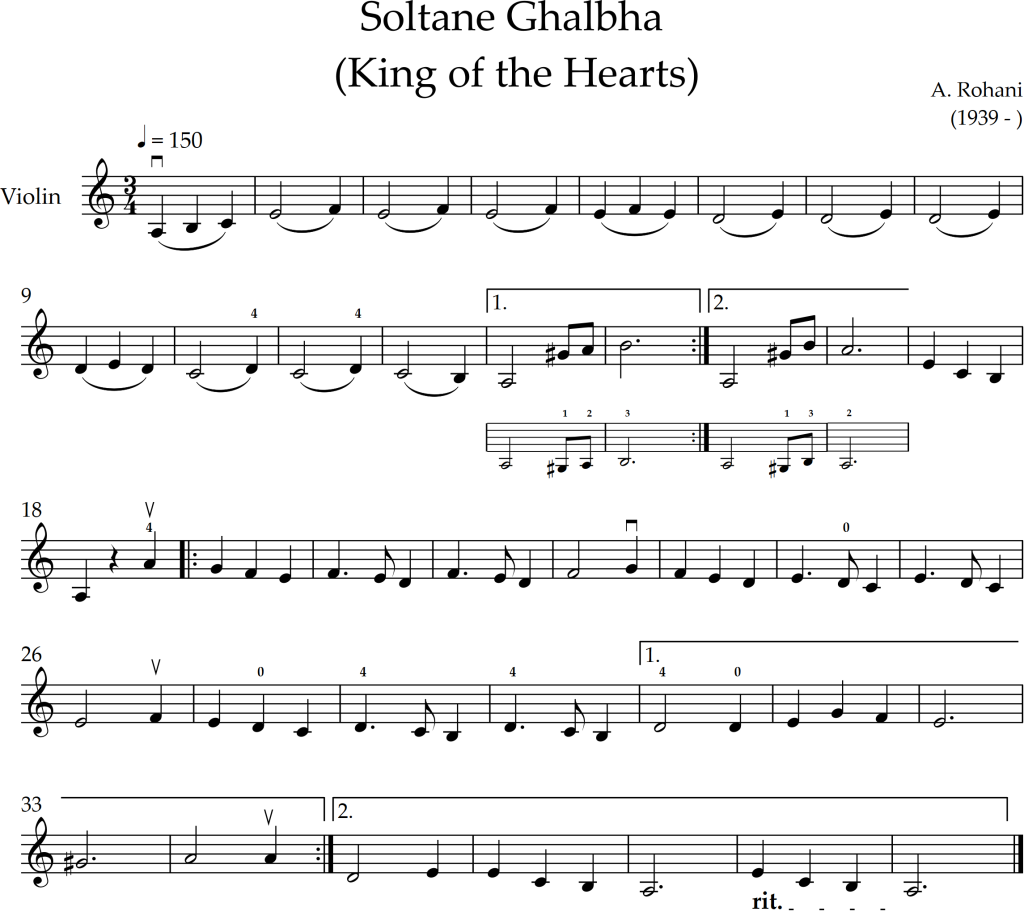
It is important to note that measures 13 to 16 can be played an octave lower to align more closely with the original melody. This octave adjustment has been introduced to make the piece more accessible for beginning students.
Conclusion
Incorporating supplementary Iranian folk tunes into Suzuki Book One provides a valuable resource for teachers working with a diverse student population. These pieces resonate deeply with Iranian students who are familiar with the melodies while offering American and other non-Iranian students a unique opportunity to become acquainted with Iranian music and culture. By integrating these tunes, teachers can create a more inclusive and enriching learning experience that bridges cultures and fosters cross-cultural understanding.
Notes
1. https://www.youtube.com/watch?v=An2B5LI2W94
2. https://www.youtube.com/watch?v=_NNS993eGd8
3. https://www.youtube.com/watch?v=PQHfjNUV9PA
References
Nematollahy, Kamyar. “Iranian Classical Music Since the 1970s: The Discourses of Tradition and Identity.” PhD diss., Universität zu Köln, 2022.
Somerford, Peter. “Mother Tongues.” The Strad. November 2024.
Youssefzadeh, Ameneh. “Iran’s Regional Musical Traditions in the Twentieth Century: A Historical Overview.” Iranian Studies 38, no. 3 (2005): 417–39. https://doi.org/10.1080/00210860500300804.
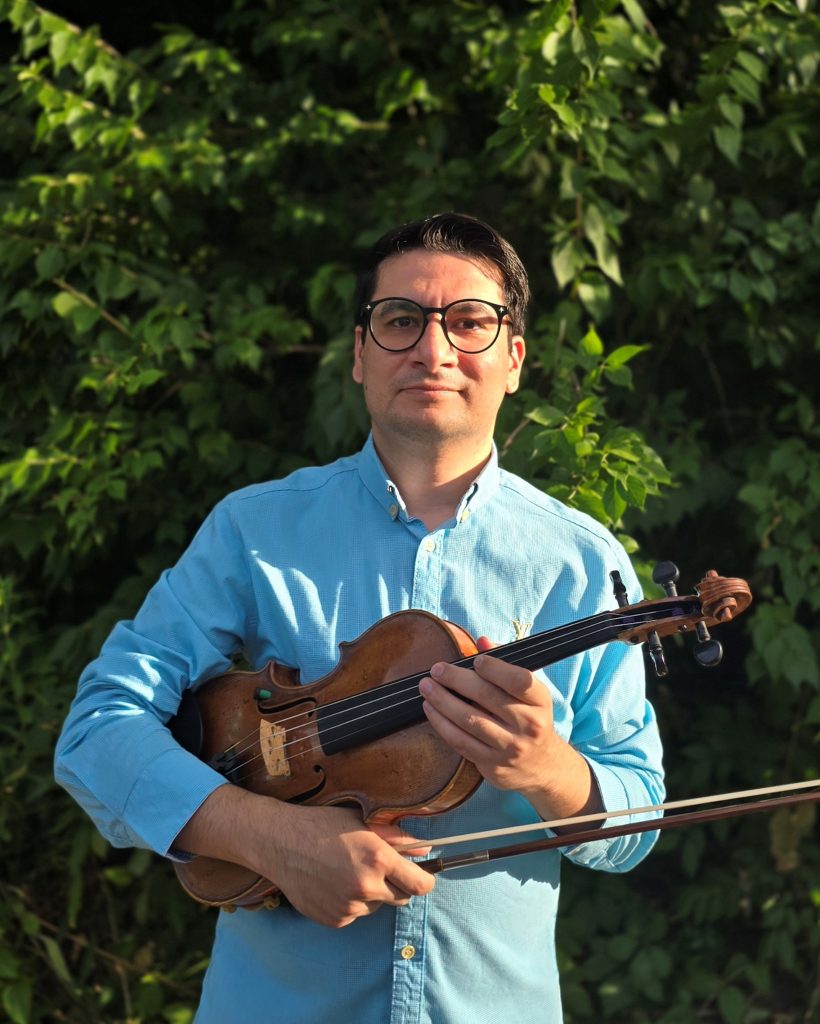
Erfan Namaki is a dedicated musician and educator, originally from Iran, currently pursuing his PhD in Music Education at the University of Illinois, Urbana-Champaign, under the mentorship of Dr. Rebecca MacLeod. With a master’s degree in Violin Performance and over 15 years of teaching experience, he is passionate about fostering musical growth in his students. Erfan is an advocate of the Suzuki Method, integrating its principles to nurture talent and inspire a love for music. Residing in Urbana, he actively teaches both online to Iranian children and in-person classes, creating meaningful connections through music across cultural and geographical boundaries.