 EN
EN  ES
ES  PT
PT  FR
FR 
Suzuki Sensei’s Spirit
While visiting his daughter near Rochester NY, my husband Warren unexpectedly ended up in Strong Memorial Hospital. A teaching hospital, Strong is known for its teams of doctors that work together to find solutions. After a week of testing, Warren was transferred to their Wilmot Cancer Center.
On our first morning in oncology, a doctor walked in with a big smile and the declaration, “I hear you teach violin. I was a ‘Suzuki Kid’.” What a surprise! I had no idea that Warren, a percussionist, had already talked to him about the “violin thing.” The doctor continued by saying, “I probably never practiced quite enough, and I wouldn’t want you to hear me now, but I still play around on the piano.”
Smiling, the physical therapist perked right up when I asked about music in her life. She played violin all through her years in a local public school and expressed her excitement and love of being in the orchestra. “Project Super,” which began in 1966, experimented with the use of the Suzuki Method for public, private, and professional music schools in upstate New York. Facilitated by Anastasia Jemplis from the Eastman School of Music, many of these schools have continued with the method over fifty-five years later. The experiment was a success with the result being students like this physical therapist.
Soon after, in came the head of Warren’s new team of doctors. This doctor had heard about the “violin thing” and let us know right away that he began violin at age seven and played into high school.
The following day the regular doctor team included a Fellow specializing in oncology. Imagine our surprise to learn that she too had played violin throughout her school years! She said that she donated her violin to a string program once she no longer found time to play.
It was hard to believe that so many of the specialists on my husband’s team had seriously played musical instruments in their youth. When we spoke with the head of the department, he was happy to add that he had studied piano. His assistant volunteered that playing saxophone all through school gave him a wonderful creative moment in his usual day.
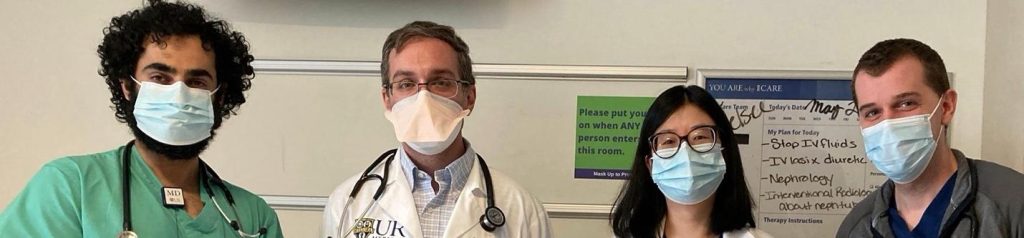
*Our team of doctors, left to right: Keyon Zarei, MD; Frank Passero, MD; Janice Zhao, MD; Brett Schuchardt, MD. *
The amazing part for me was the intense sense of calm I had when finding out that, at some point in their lives, these professionals had played music seriously. I relaxed completely. We were in the right place. Warren was being taken care of by those “kids” who had grown up.
How did this particular group of doctors end up on Warren’s team? Luck? Perhaps. Unusual, at the least. Interestingly, their musical backgrounds helped me extrapolate enough that I became quite calm during what might have been a very stressful situation. Dr. Suzuki always said that playing a musical instrument could help develop character. By knowing a tiny bit of their musical backgrounds and watching them work, I felt like I could “deduce” more about each of these particular professionals than I could ever imagine.
What carryovers from hours of practicing and performing music might be helpful to these medical specialists?
- I believe that they have strong memorization skills. Those skills, necessary in music, probably serve them well in their medical studies and professional lives.
- I presume that they can remember the names and effects of the medicines, lab results, and procedures that they prescribe. That knowledge helped me relax a little on each of those concerns. Just the number of abbreviations for all the tests and their results is overwhelming.
- I postulate that their arm, hand, and finger coordination could be unusually advanced. When they learned such skills as playing in tune, vibrato, shifting, and other proficiencies, their fine muscle development probably ended up exceeding the norm.
- I notice that they listen very carefully to the vocal nuances in the patients’ questions and answers. Hesitant answers are rephrased to gain deeper understanding, like replaying the same phrase differently the second time.
- I anticipate that they are strong-minded, dedicated, caring, kind, and thankfully very careful.
- I expect that, sometime in their lives, they each felt that trying to help others was important to them.
Just as studying a score helps a musician discover more information and adjust their interpretation, the doctors continue with their team of specialists, refining the diagnosis and making sure they are on track to help their patient. The diagnosis can change as more information becomes available and the diagnosis is refined. The doctors always explain the reasons for changes and help us understand what is next.
It felt like these doctors were following through on Suzuki’s goal of having students be hard workers with sensitive hearts. He hoped children would become specialists, with a high level of knowledge and experience, who also know how to show empathy.
Besides the important effects of serious music study, Dr. Suzuki wanted teachers to take care of their students’ hearts. In fact, Dr. Suzuki wrote in Man and Talent:
I am not engaged in this movement in order to foster musicians. If every ordinary citizen can grow as a person with musical sensibility or a person with an artistic quality which benefits a human being, the whole nation will become better. I sincerely hope for the advent of an era when every individual on this globe will have such artistry.
I will forever remember how soothed I felt when one of those grown-up “Suzuki Kid” doctors went from standing to down on one knee in order to hand me a tissue at my eye level.
Music teachers can reflect and easily recognize that we are guiding, on a daily basis, not only the skills of playing an instrument, but also shaping the kindness and respectful qualities of our students. What we are doing matters. Our students matter. Their families matter. Our fellow teachers matter. Onward!