 EN
EN  ES
ES  PT
PT  FR
FR 
Stressed Out: Living and Learning Under Pressure
By Zachary Sweet

Whether you are a teacher striving to support your students’ wellness and progress, a parent raising a busy child, or a teenager curious about improving your abilities, stress management is critical in today’s world. No amount of memory development, fine motor skill training, or rehearsing will reach its full potential under stress—we have to support the whole human.
Stress, an intrinsic inability to relax the body and mind, is avoidable, while pressure, a reaction to a situation where there are expectations, is common. Adolescent and young adult brains develop emotional regulation, impulse control, and problem-solving skills in the prefrontal cortex until ages 25–30. These maturing young people need informed support as they attempt to keep stress at bay while navigating an ever more complicated society.
Today’s world presents unique challenges compared to past generations. While high school in the 1990s involved similar extracurricular activities and competitions, students today face a “perfect storm” of social media, mental health concerns, and escalating performance standards. Additionally, young people grapple with existential concerns about their futures, global events, and personal identity.
Stress makes students stiff, insecure, and hesitant—qualities that inhibit health and effective learning. As educators, our technical and musical coaching matters little if the student in front of us is overwhelmed. All stress—real or perceived—activates the same biological process known as the “fight-or-flight” response. While this system helps in short bursts, chronic stress keeps the body in overdrive, leading to inflammation, cellular damage, and long-term health risks if hormone levels don’t normalize.
If we accept the realities of living with pressure and stress, we can begin to understand how to not just get by, but how to flourish in all situations. This article offers students, teachers, and parents strategies for navigating and balancing stress in learning environments.
Finding Joy in the Process
As we age, we often forget the role that joy plays in health and learning. Susan Magsamen and Ivy Ross emphasize this in Your Brain on Art:
Our brains love humor. Genuine laughter lights up multiple regions of the brain starting with the frontal lobe, your control tower, as it unpacks the information coming in to discern whether it’s funny or not. From there, electrical signals spark the cerebral cortex into action and you laugh, which activates the brain’s reward system, releasing dopamine [and] serotonin.
Engaging students with playful challenges, imaginative exercises, or varied methods of practice help sustain their long-term motivation. It is essential that we know what is individual to them and reflect these elements in our approach. Some ideas include:
- Gamify Practice, no matter the age: Set creative challenges within practice sessions and long-term planning.
- Incorporate Personal Interests: Leave time for pieces the student genuinely enjoys and ideas unique to their experiences. The more they see themselves in the process, the more connected they will be to it.
- Break the Routine: Explore new genres, methods, and favorite old pieces as a refresher. Time at the instrument may not be the best way forward. Would composition help this student understand melodic shape? Would choreography bring to life a mood or style that is yet unfamiliar?
The Power of Breaks
Repetitive, mindless practice does not serve progress. Set intention and take breaks to allow the body and the mind to forget just enough before returning to it to promote deep retention. This was a hard lesson for me. I felt a constant urge to touch the instrument and run the same passages over and over again out of fear of forgetting; classic over-practicing.
As Molly Gebrian, a professional violist with a background in neuroscience, writes in her book Learn Faster, Perform Better, “Breaks aren’t wasted time: they are the most important time for skill improvement.” Do yourself a favor and read this book to incorporate its lessons into your day-to-day lives. Here are some practical applications:
- Take strategic breaks throughout your practice to improve retention.
- Avoid over-practicing what you already know—focus on weak spots. Incorporate reliable skills in a broader approach, like visualization.
- Set up informal performances to identify areas needing improvement. This could be for friends and family or recording yourself to observe later.
The Importance of Sleep
Sleep is fundamental to memory, emotional regulation, and physical coordination. A 2023 Mayo Clinic statistic noted that sleep deprivation slows reaction times by fifty percent. The recommended sleep is ten hours for children ages thirteen to eighteen, and twelve hours or more for younger children.
I know that my current students are not getting enough sleep by as much as three to four hours. AP exams, social media, video games, and general anxiety all contribute to an alarming lack of rest. More frequently, my teenage and college-aged students are coming to lessons dramatically fatigued. What can we possibly accomplish in a constant state of depletion? In terms of learning, a lack of sleep affects all stages of learning: acquisition, consolidation, and recall. New research continually emerges to support the claim that if we want to help our students’ wellness and progress, we have to support better sleeping habits.
For those struggling with sleep:
- Prioritize naps when nighttime sleep is insufficient.
- Develop healthy pre-sleep habits to reduce stress about falling asleep.
There is a recognizable limit to what teachers can do here, but we shouldn’t underestimate the power of connection. The Suzuki triangle offers a vehicle through which these changes may catalyze.
Managing Expectations
Teachers
Adjust workloads around major events or moments of childhood development. Not all weeks are equal. For older students, know their commitments and desires so you can plan effectively. If the concerto competition falls on the same week as a midterm or tech week for a musical, can we bump that etude to two weeks from now? Help your students plan to prioritize what is necessary. For younger students (and sometimes older), we know that so much of the process is human development. Adjust the lesson and weekly plan for bouts of stubbornness, transitions of time, special events, or just basic temperament.
Parents
If something seems to be in flux with your child, Dr. Vivek Murthy’s checklist from Together: The Healing Power of Human Connection is a useful tool to assess daily balance.
1. Social connection: Is there face-to-face time?
2. Extracurricular activities: Too much? Too little?
3. Family time
4. Shared screen time to establish healthy digital habits. One to two hours of screen time seems to be the magic number
5. Free time: Unscripted, homework doesn’t count
6. School performance
7. Basic wellness (hygiene, eating, sleeping)
Life today seems like an ebb and flow of schedules and tasks. My heart goes out to you. Look to your teacher(s) for long-term tracking and support because we often have the privilege of knowing you and your family for more years than those in other systems. Share your concerns openly and honestly to normalize wellness as an important dialogue.
Students
Be honest about your intention because you can’t actually be good at everything, all the time. Like it or not, something takes a back seat when you are over-scheduled, underslept, and ignoring key health indicators. From my perspective, extracurriculars are far too demanding and inflexible, so it falls to you and your parents to prioritize. If something that is supposed to be fun takes all of your time away from other things that are also important to you, you might have to let it go. While the fear of missing out is a real struggle, the value of your time and energy is even more important. Ask yourself the following three questions to assess the value of extracurriculars:
- Is this activity still bringing me joy?
- Is my time balanced across my priorities?
- What can I let go of to maintain my well-being?
Normalize wellness as part of learning, not separate from it. Children absorb more than just music at lessons; they internalize the emotional tone of their community. Regular stress check-ins can mitigate long-term effects and create space for emotional regulation. By addressing stress and encouraging healthier alternatives, we become more empathetic educators, supportive parents, and fully realized people. Sometimes, just showing up is good enough.
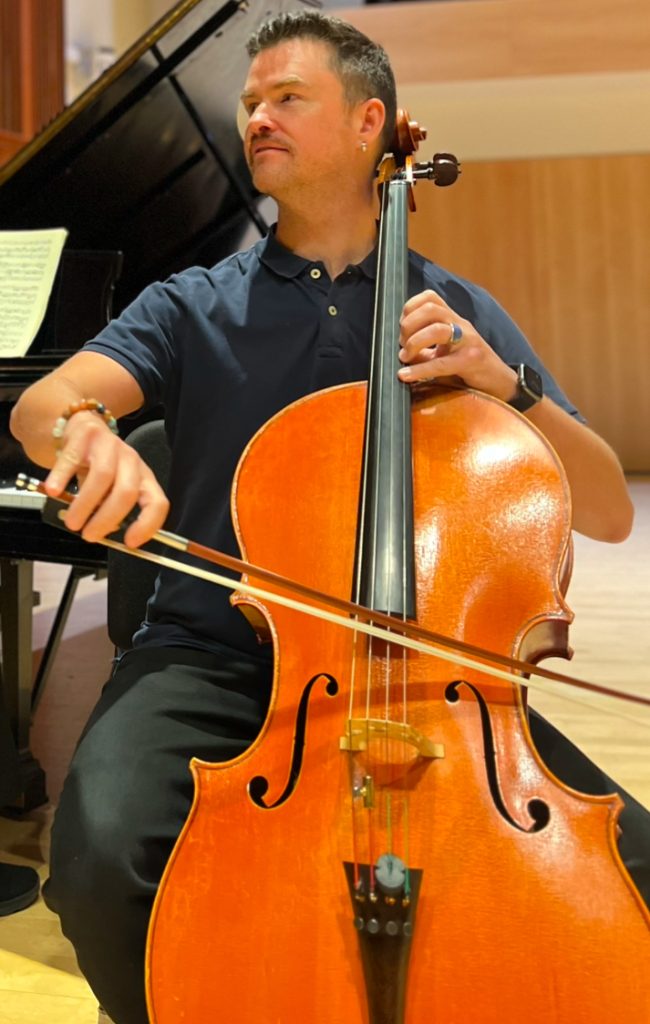
Zachary Sweet is a registered Teacher Trainer with the Suzuki Association of the Americas. He is currently an instructor of cello at Nazareth University, Binghamton University, and on the faculty of Ithaca Suzuki Music Education. Nationally, he is in demand as a clinician, having led workshops, masterclasses, and institutes across the United States and Canada.